Tuesday, October 6, 2015

WotA Tutorial 3: Campaign Aspects and Reincorporation

Now that the Wrath of the Autarch kickstarter is in full swing, I thought I would discuss some other aspects (heh) of the kingdom building game that might be of interest to Fate Core players. In particular, how Wrath of the Autarch handles aspects that have impact at different timescales.

If you haven't heard of Wrath of the Autarch, check out the kickstarter here: https://www.kickstarter.com/projects/295104591/wrath-of-the-autarch-a-kingdom-building-game

Aspects at Different Timescales

A Sunrider Visits Her Clan's Ovoo
Wrath of the Autarch has aspects which occur at three distinct timescales: minor advantages, mission aspects, and campaign aspects. As well as having varying timescales, the longer lived aspects typically have a more central role in the campaign.

  • Minor Advantages - These are very short lived transient aspects, similar to boosts. They can be created as an action during either the challenge phase or the final conflict. Usually, minor advantages are not written down. Furthermore, they don't last beyond the end of the creating player's next turn.
    • FlankedEmbarrassed, Hidden
  • Mission Aspect - Mission aspects are created during the challenge phase as an action. They last until the end of the current mission (the end of the season). As such, they tend to be harder to create. Mission aspects are usually created during the challenge phase for use during the conflict.
    • Wolfsbane, Heinrich's Password Convention, Curio for the Prince
  • Campaign Aspect - Campaign aspects are created during the challenge phase as an action. They're written down on the Stronghold sheet and last the entire campaign (or until they're no longer applicable).
    • Sword of Kynian, Contact within Autarch's Spy Network, Angry Hearts in Burgan Vale

Create Advantage as Scene Creation

Creating mission and campaign aspects is a bigger deal than creating minor advantages. These aspects can't be created during a conflict and can't be created if a character is in a challenge scene. Instead, the creation of these sorts of aspects is handled as their own scene. The Stronghold player who wishes to create the aspect sets the scene on their turn, then uses the appropriate skill to see if they're successful.

The opposition for creating mission aspects is equal to the difficulty of the mission. The opposition for creating campaign aspects is two higher than the mission.

Example: Rebecca is playing Varys, the silver tongued sorcerer from Aben's Hollow. He is deep within the Imperial library at Northkeep, looking for a particular book of Secrets. "Varys is trying to find the Whispers of Kynian, famed for revealing the secrets of the mind. I'd like to create a campaign aspect."

The mission difficulty is 4, so the opposition to create a campaign aspect is 6. Varys is using his Lore skill, which is 5. Rebecca gets a +2 on the check, success! She writes down the aspect Whispers of Kynian on the Stronghold sheet with one free invoke.

Reincorporating Campaign Aspects

By virtue of writing these aspects down on the Stronghold sheet, they become reincorporated over the course of the campaign. This is a particularly nice feature for Wrath of the Autarch given that there is no gamemaster. Typically, reincorporation of thematic content is one of those elements that gets forgotten without one strong driving force. By writing campaign aspects down they become important and explicit.

The Autarch player also sometimes is able to create campaign aspects to reflect negative situations - such as Angry Hearts in Burgan Vale. During a related mission, the Stronghold players could attempt to deal with this as an overcome action.

Friday, February 20, 2015

WotA Tutorial 2: Challenge Scenes

Challenge Scenes

During the challenge phase, the players work together to craft challenge scenes that drive towards a climactic conflict (the conflict is the final part of the mission). The Autarch player may add additional complications to challenge scenes - making them more difficult to resolve. The players need to complete one challenge per Stronghold player, and they only have three exchanges to do it! Failing to do so in the given time gives the Autarch player additional fate points for the conflict. The challenge phase is also an opportunity for the Stronghold players to make longer term plans in the form of campaign aspects.

The Stronghold players each take one of two actions during the challenge phase: resolving a challenge scene (Overcome) or creating aspects (Create Advantage). Wrath of the Autarch uses three types of aspects: minor advantage, mission, and campaign. The challenge phase is the only time mission and campaign aspects may be created. Creating mission and campaign aspects may only be done when heroes aren't in challenge scenes (creating mission and campaign aspects involve short scenes of their own).

Conquering North Oaks

For this example, Steingrimr the Noble Barbarian, Aine the Headstrong Ranger, and Arild the Hollow Eyed Assassin are attempting to wrest the neutral region North Oaks from the necromancer Malthias. This is a Conquest (Skirmish) mission with a difficulty of 3 - fairly easy as these things go. Let's go through one exchange of action! Each Stronghold player takes a turn in any order they wish.

Creating a Scene

If a hero isn't already in a challenge scene, they may create a new scene as part of their action. Aaron, playing Steingrimr, decides to create a scene. A fate card is drawn and used to create the scene.

Creating a Challenge Scene

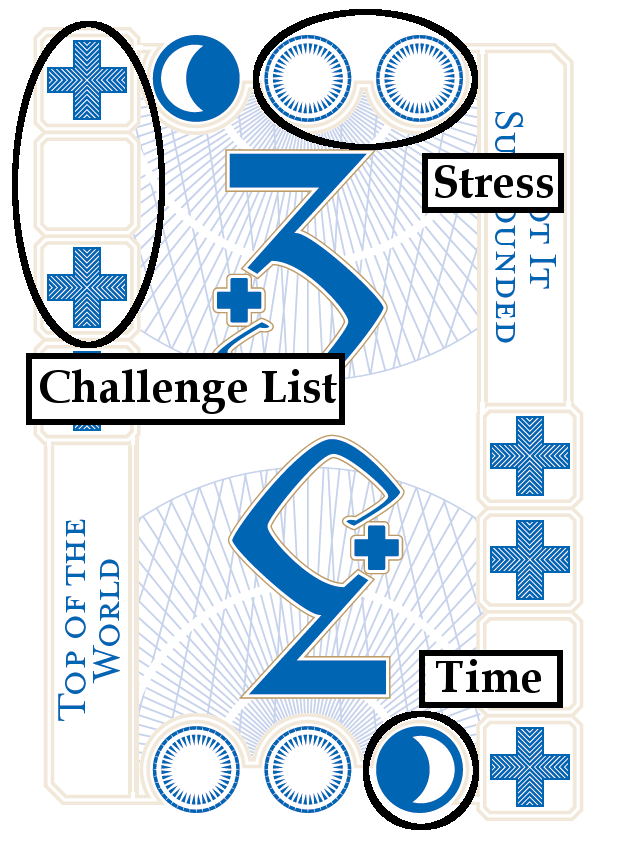
A challenge scene is composed of:
  • A difficulty (the result of the card plus the mission difficulty)
  • Allowable skills for resolving the scene (found by looking at the appropriate Challenge list)
  • (Sometimes) Stress taken when resolving the scene (suns)
  • (Sometimes) Additional time needed to resolve the scene (moons)
  • Heroes in the scene

Challenge Scene Details
The first three dice on the card are used to determine which entry from the Skirmish Challenges list to use. Looking at the Skirmish Challenges list, the result for this card is the On the Run, which must be resolved using Fighting and Survival. The phrase On the Run is used to help inspire a theme for the challenge scene. In addition, the moons (additional time) and suns (stress) help inspire the narrative of the scene. Scenes flow together, taking into account the mission, campaign aspects, and other influences to help craft an interesting narrative.

The difficulty of this scene is 6 (mission difficulty of 3 plus 3 more for the result on the card) - not very easy! The two suns and one moon indicate it's both stressful and time consuming. Aaron decides that the scene involves a bone golem Malthias' has constructed chasing the heroes through the dense woods. The giant beast is chasing them from their encampment, attacking with a massive club, bashing tree limbs and hero limbs along the way. The heroes are attempting a controlled withdrawal, trying to escape the beast.

Since Aaron drew the card, Steingrimr must be in the scene. The other characters may be in the scene at their option. Heroes in a challenge scene may not create mission or campaign aspects (only minor advantage may be created while in a challenge scene), so occasionally it's worth not joining in a scene. However, this is an all hands on deck situation, so both Aine and Arild are with Steingrimr!

Steingrimr Attacks (Resolve Challenge)

It's Aaron's turn (he drew the card). He may either create an advantage or try to resolve the challenge. The moons must be removed before the challenge may be successfully completed. The opposition for this task is equal to the number of moons (one). Usually this is easier, but it makes the scene take longer.

Steingrimr is a warrior, with a Fighting of +4. Aaron decides to try to remove one of the moons using the Resolve Challenge (Overcome) action rather than creating an advantage. He gets a -2 - for a total of +2, success!

Additionally, every time the resolve challenge action is taken, the hero takes all of the suns on the card as physical or mental stress (up to the player). Steingrimr waits behind a tree, lunging out and smashing the beast! It hits him back, Aaron marks the second box on Steingrimr's physical stress (from the two suns). This buys the group more time to retreat, but the beast takes its toll!

Aine Provides Cover Fire (Create Advantage)

Aine's player, Shawn, decides to lay down defensive fire to buy time for Arild to find shelter from the beast. This takes the form of a Create Advantage action. Only minor advantages may be created while in a challenge scene. Furthermore, only other characters in the same scene may utilize these minor advantages. The difficulty to create a minor advantage is two less than the mission difficulty (in this example a mere +1, since the mission difficulty is 3).

Shawn decides to use Marksmanship to create an advantage. Any appropriate skill may be used for the creation of advantages. Skills used for resolving a challenge are restricted to those on the challenge list (in this case Fighting and Survival). Aine's Marksmanship is +4, and Shawn gets a result of +1 for a total of +5. Success with style!

Shawn creates the aspect Covering Fire, giving it two free invokes from success with style.

Arild Finds Shelter (Resolve Challenge)

Finally, Arild must take an action. With the two free invokes, Geoff, Arild's player, decides that Survival might be a good way to find a path out of these woods and away from the bone golem. The difficulty is +6 to resolve the challenge scene. Not so easy, but armed with the free invokes from covering fire, Arild has a much better chance of success.

Arild's Survival is +3. Geoff initially gets a -3, ouch! Using one of the free invokes, Geoff re-draws, getting a +2, much better! The total is now +5. Using the other free invoke to add +2 to the result, the result is +7, success! However, Arild must take two stress from the two suns on the challenge scene from using the Resolve Challenge action. Geoff marks off the second box on Arild's mental stress track.

Also, because the difficulty of the opposition was higher than Arild's Survival skill, Geoff may mark off one skill advance box for Survival. When a character has three skill advances they may improve their skill rank. Skills only advance this way during the challenge scene, not during the conflict.

While Aine keeps the beast at bay, Arild studies the landscape carefully. His trained eyes spot a narrow cave entrance on the side of a hill. The heroes rush towards it, escaping the beast! Geoff marks off Arild's second mental stress box (from the two suns) - the close call impacted Arild's nerves!

Friday, January 16, 2015

WotA Tutorial 1: Trading for Fun and Profit

This is the first in a series of posts designed to highlight the kingdom building game Wrath of the Autarch through examples of play. For a general overview of Wrath of the Autarch, see here: http://grue-fodder.blogspot.com/2014/06/what-is-wrath-of-autarch.html

The beta rules can be found here: https://sites.google.com/site/frontiergamedesign505

Stronghold Upkeep

The first part of every session is dedicated to Stronghold Upkeep: applying ignored threats, gathering resources, trading with other factions, feeding the population, and building developments. Developments are sort of like stunts for the Stronghold. They may improve the Stronghold's ability to wage war or they might grant access to better resources for all of the heroes associated with the Stronghold. This tutorial focuses on the process of getting resources and using them to build developments.

Hope Springs Eternal

It is the Spring of Year 3. The Stronghold of Aben's Hollow plans an Alliance mission to visit the Gravewood, their ally, beseeching them for aid in the coming battle with the Empire. Luckily, there were no threats at the end of last season, so all their regions are available to them. Aben's Hollow controls the following regions:
  • Obsidian Wood - 1 food, 2 timber, 2 mana
  • Echo Lake - 2 ore, 1 luxury
  • Tarrydale Farms - 2 food
  • Green Vale - 1 food, 1 ore
  • North Oaks - 1 timber
  • Totals: 4 food, 3 timber, 3 ore, 2 mana, 1 luxury


A Fickle Harvest

The first step is to gather six sided dice for each available resource. It's easiest to use different colors of dice for each type of resource.
Gather resource dice: 4 Food, 3 Timber, 3 Ore, 2 Mana, 1 Luxury

After all the dice are gathered, they are rolled by the spotlight player to determine the specific amounts of each resource available. Rolling the dice represents all the fickle supply issues that can impact seasonal harvest and usage. Each session a different spotlight player is featured. (The spotlight player has additional importance besides managing resources for the session.)
Roll dice: Food: 5,3,3,2 Timber: 4,2,1 Ore: 2,2,2 Mana: 5,3 Luxury: 3

Tactical or Strategic Development Building

Each development has resources requirements and possibly other developments that must be built first. When building a development whole dice must be assigned to reach the resource total. The values on the rolled dice may not be split up.

It's best to look at what developments are desired, and then decide whether to get the one that is really desired (thinking strategically) or try to optimize the rolled dice to get as much as possible (thinking tactically).

For the current mission Aben's Hollow is on (Alliance), either Trade Relationships or Arts and Entertainment would be nice. They could also prove useful in the future as well. Another really nice development that Aben's Hollow wants is the Mana Forge given they have lots of spellcasters associated with the Stronghold.
Aben's Hollow doesn't have enough luxuries to get either of these
Unfortunately, Aben's Hollow only has 3 luxuries total, which is too low for either of these. They also only have 7 timber, which is too low for Arts and Entertainment.
Aben's Hollow could pick this one up
Mana Forge is available and useful. Most likely they could get this and something else.

Wheeling and Dealing

What to do if you want more resources? Trade! There are five minor factions in the game, and they each desire and give different resource dice. The particulars of the trade are based on the disposition with the faction. Disposition ranges from -6 to +6. The higher the disposition, the better allies they are and the better the trades are going to be. (High disposition also might allow access to military units and powerful artifacts from the faction.)

Aben's Hollow has the following dispositions with minor factions:
  • Gravewood: 2
    • 1 luxury die for 2 timber dice
  • Sunriders: 3
    • 2 mana dice for 3 food dice or
    • 1 mana die for 1 food die
  • Lily Manor: 1
    • 2 food dice for 1 luxury die
The Stronghold may trade with each minor faction only once each season, by placing the number of required dice onto the faction trading chart, and taking the number of dice of the appropriate type. The dice given by the faction are rolled immediately and added to the pool of dice. There is a strategy in trading away the lower valued dice and using the resources the faction gives back to build developments that couldn't otherwise be built.

Aben's Hollow could get a luxury dice from Lily Manor that could be used to build the Trade Relationships development. They'll need a little luck, though, needing to roll a 4 on the dice they get to reach a total of 7. 

Before they do that, though, they could take their mana dice (either 1 or both) and trade them with the Sunriders to get more food dice. That would mean no Mana Forge, though, because they wouldn't have enough mana. But those food dice would give more options when trading with Lily Manor - wheels of commerce spin!
Give two mana dice to get three food dice
Instead of trading 2 mana for 3 food, Aben's Hollow could also trade 1 mana for 1 food. It's not as good of a rate, though, and it doesn't look like the single mana die will be useful for anything.
New food dice are rolled (5,2,1), mana dice are gone

The dice are rolled: 5,2,1. Not great. The 2 and 1 food die are traded to Lily Manor for 1 more luxury die. This is rolled and... 4! Trade Relationships is now possible to get!
Allocated resources for Trade Relationships

All that remains are food dice - 5,5,3,3,2.

The Power of a Luxury Based Economy

One other use for luxuries - they can be spent to re-roll any of one type of resource die. There aren't any left over after this, but this is a powerful use for luxuries. Luxuries are hard to come by!

Feeding the Masses

Finally, an amount of food equal to twice the number of regions must be spent to feed the people.

Aben's Hollow controls 5 regions, so they'll need to allocate 10 food or suffer stability loss. Luckily, they can put the two 5 dice and exactly meet the requirement, with the 3,3,2 food dice left over!

Leftover Resources for Spotlight Fate Points

Two resource dice may be spent to give the spotlight player an additional fate point to start the mission.

Aben's Hollow is left with three dice. Two of those could be used to give the Spotlight Player one additional fate point for this mission. Alternatively, an infantry unit could be mustered for 6 food. The Spotlight Player decides it would be better to muster an additional unit rather than get one fate point.

Wednesday, August 6, 2014

Campaign Frame Thoughts

Currently the campaign ends when the stability of either the Stronghold or the Empire drops down to zero. There's also a way for the Stronghold to end the campaign by assassinating the Autarch. I had in mind that there would be some sort of attack by the Autarch afterward.

Ultimately, what I'm interested in is a session that feels like a true finale. Thus, basing the whole campaign around stability may not be the best approach. It makes stability very important in terms of winning, but if it directly impacts how easy it is to win a mission, then the win condition and the resource needed for success are tied together, which isn't a great design choice.

Thinking about the mission types and how they might function in winning, there are:

Stronghold Victory Paths

Warfare - Attacking the Empire's capital wins the game for the Stronghold. This seems like a suitable finale for the campaign. It's really hard to do (capitals can be defended with more units, and the Autarch has a castle there). It will probably happen suitably far in, so the Autarch would be featured in the defense of the capital.

Infiltration - Assassinating the Autarch is another way to win. This is a difficult mission as well. It doesn't feel quite as nice of a resolution, because the Autarch wouldn't be able to defend directly as easily. However, it's so difficult, that it would be something that also would tend to happen far into the campaign.

Autarch Victory Paths

Warfare - Similar to the Stronghold, the Empire can win by attacking the Stronghold's capital. For all the reasons it's difficult for the Stronghold, it's difficult for the Empire.

Skirmish? - The Empire uses Skirmish instead of Infiltration to assassinate heroes. Unlike for the Autarch, though, a hero could get assassinated and the campaign could continue on. Of course, if enough heroes get assassinated, it's functionally over.

Wrath of the Autarch - Alternatively, maybe, at some particularly late stage of the campaign, the Autarch player could force the issue, and start a mission for all of the marbles. If the heroes fail, the Stronghold gets nuked by some sort of powerful magic. This is basically the "Arkham Horror" way to end the campaign.

Support Paths

Diplomacy - In this case, diplomacy doesn't become a primary strategy. It's still very useful, basically essential, in terms of trading goods and building developments, but it's not a primary way to victory.

Skirmish - Skirmish is important, as it's a way to get neutral regions, and many quests use Skirmish. It also would be important for defense if there is some sort of Wrath of the Autarch mission that ends the campaign. In that case, building toward that end point could be a way to win for the Stronghold.

Uses for Stability

If stability is no longer the primary mode for victory, it could play a bigger role in terms of impact on missions. It would also be okay if it swung around more.

Thematically, it also felt a little weird - both the Autarch and the Stronghold basically lose stability over the course of the campaign. It seems like the support of the people should be independent of victory.

I'm not sure what role stability should have, then? It seems like making missions easier or harder is probably a good place for it.

Some options:

  • Starting Fate Points - Starting fate points might be an option. If it's lower/higher each side starts with more or less fate points.
  • Resources - I'm hesitant to have stability affect resource dice. If it does, it can cause a downward spiral that is impossible to recover from. It also would hit the Stronghold far more than the Autarch, because the Autarch doesn't use resources.
  • Campaign Aspects - It's always an option to make new aspects in relation to stability swings.
  • Mission Difficulty - If a mission takes place at a faction, the difficulty could be modified by the stability of the faction. This is a really powerful

Summary

I'll have to think about how stability would be used, but I do like having the campaign end in only one of these few ways. I also do like a "Wrath of the Autarch" timer, which basically can trigger if the campaign goes on to long. It's a for good or worse, this is the end, sort of event, which could be good to have.

Sunday, July 20, 2014

Streamlining Mission Types and Factions

Even though I've been conscious of trying to minimize complexity while designing Wrath of the Autarch, I haven't really hesitated to throw in everything and the kitchen sink in order to get it to work.

I'm currently in a contraction phase, brought about by seeing trends during playtesting. I've thought of a number of areas which could be streamlined without losing much, if anything, in terms of strategy or interesting choices.


  • Trade Missions / Trade Tracking
    • Setting up particular trades (X ore for Y timber, etc) and then tracking them is pretty fiddly and not all that interesting
    • Instead, Trade Missions (which may need to be renamed Gain Support or something like that) should just increase disposition with the target faction
    • Each season, trade is optionally done with factions based on what their disposition to the Stronghold is
      • This is a little more fiddly than what I currently have, since the Stronghold players have to decide if they want to trade. Usually the answer will be yes, so hopefully it's not that fiddly
    • Because of this, only the disposition with the factions would need to be tracked, not specific trades
    • It also makes the Gain Support (previously Trade) missions make more sense. All the fiddliness of setting up a trade, and determining difficulty is gone. It also will make more narrative sense, putting the focus squarely on gaining support for the Stronghold, with most of the issues revolving around the conflict between the Autarch and the Stronghold
  • Factions and Developments
    • I constructed most of the factions similarly to the Stronghold, with regions, developments, units, stability, population, etc
    • I don't think the factions really need development listings
    • Instead, they should just have stats based on how difficulty various types of conflicts are
      • Ex. Skirmish 4, Infiltration 3, Warfare 6, Diplomacy 5
  • Infiltration Missions
    • There are three infiltration missions: Espionage, Sabotage, and Assassination
    • Each of these mission types has various options for them
      • Many of these options relate to the developments each faction has
    • These should probably be streamlined, to focus their intention
      • Sabotage: Lower the target faction's stability (that's it)
      • Espionage: Make it easier to build a development (each one of the five factions will have one of the five tech trees they're good at)
      • Assassination: Kill a leader (that includes the Autarch)
    • All of the other various options are scrapped (and worse, the need to not only know what mission type to do, but figure out if faction X has development Y)
    • Assassination missions aren't all the useful right now, so the leaders for each faction need to have decent role in what makes the faction good at tasks - killing a leader nerfs the faction's effectiveness
  • Resources
    • At some point, I need to go through the neutral regions that can be found with exploration, and really make them specialized (as in, good at providing a particular type of resource)
      • Right now, many of them are sort of a mush
    • I also need to go through, and make sure all the resource numbers are as low as possible
      • Some resource amounts were sort of arbitrarily inflated (like timber) in order to create various trade charts. Not sure what I was thinking there - but all the numbers should really be as low as possible to keep the math simpler and make it easier to form strategies

Friday, June 6, 2014

What is Wrath of the Autarch?

Bandits are stealing your grain, a border dispute has ignited with Crescent Hold, and the peasants are uprising ever since your guard accidentally murdered an innocent. Amidst all of this, the Autarch's spies are everywhere... it is only a matter of time before they launch a full scale assault. There aren't enough resources to deal with all of these threats, but what gets ignored?

Wrath of the Autarch is a kingdom building role-playing game. The beta rules are complete and freely available here: Beta Rules

I'd love to hear from you! Please post your thoughts in the WotA G+ community: G+ Community or the WotA rpggeek community: WotA on RPGGeek

Wrath of the Autarch features:
  • Domain Management
    • WotA owes its inspiration from 4X video games, and role-playing games like Birthright, Houses of the Blooded, and Pendragon
    • The main character in WotA is the Stronghold, a society the players grow over a number of seasons
    • The Stronghold controls regions, large areas of land that can be used to gain valuable resources
  • Troupe Style Play
    • There are a limited number of available heroes for the Stronghold. These heroes are leaders and skilled characters capable of accomplishing important missions
    • Each session of play highlights one season of time, focusing on one important mission for the Stronghold
    • The players choose which heroes to play based on the type of mission they elect to undertake
  • GMless
    • WotA is a set of rules written for a specific campaign included with the game
    • The Empire of the Autarch is a powerful kingdom bent on the Stronghold's destruction
    • One player takes on the responsibilities for managing the Autarch, while the other players all manage the Stronghold
    • The Autarch player allocates points to various threat pools over the course of the campaign, which lets them inflict miseries upon the Stronghold
    • There is a strategic interaction between the missions the Stronghold takes as seasons go by and the threats the Autarch wields against them
  • Campaign Frame
    • There are five different minor factions present in the world, each with different goods and services they're willing to trade for, as well as different capabilities they possess
    • Allying with compatible factions is a key part of the strategy for the Stronghold
    • The Autarch may sabotage relationships with minor factions using threats
    • The factions and the world they inhabit is not fleshed out in detail, giving players a framework to use, but plenty of mechanisms to make it personal and unique
  • Structured Missions
    • Each season the heroes from the Stronghold go on one mission
    • The mission choices are alliance, conquest, assassination, sabotage, or dealing with a looming threat
    • Missions consist of a challenge phase and a conflict phase
  • Challenge Phase
    • The challenge phase is open and flowing, with all the players contributing to the unfolding narrative
    • There is a constant time pressure to succeed at the challenges for the Stronghold players
    • The Deck of Fate is used to help spur creativity and create challenge scenes
  • Conflict Phase
    • WotA employs four types of conflicts: diplomacy, infiltration, skirmish, and warfare
    • The type of conflict used depends on the mission
    • Conflicts use similar action types, but each have their own flavor and tactical options
  • Based on Fate Core
    • WotA is based on the Fate Core rules, and uses the same four core actions, as well as the familiar skill ladder, stunts, and aspects
    • Instead of one type of aspect, there are three, based on their duration: minor advantages, mission aspects, and campaign aspects
      • The longer the duration of the aspect, the more important it is, and the harder it is to create
    • WotA heavily uses the Deck of Fate (although Fate Dice may be used instead)
    • Stunts, developments, and other effects modify how the cards are used
    • Stress for success is an option to succeed with cost for any action type: allowing a player to increase their result by drawing cards and applying the suns as physical stress and the moons as mental stress
    • A unique relationship mechanic is used that rewards both helpful and hindering relationships
    • There is a special system called "aspect burning" which lets players convert free invokes on campaign aspects into other in game effects (units, familiars, allies, advantages in conflicts)
I've tried to provide an overview of the key features that distinguish Wrath of the Autarch from other role-playing games. If it sounds interesting to you, feel free to look over the rules and comment!

Friday, January 31, 2014

WotA, Fate, and Step Dice

I've posted about alternatives to Fate dice before, and it's an idea I keep coming back to as I work on Wrath of the Autarch. Mainly this comes in the form of varying a single dice by steps (d4, d6, d8, d10, etc) and then subtracting d6 from it. The baseline roll of d6 - d6 is a slightly more chaotic approximation to 4dF.

One of the motivations comes from compels. Traditional Fate compels aren't a good fit for the game. Their function is typically to introduce narrative complications into a character's life. They propel the story forward and add new wrinkles.
Will a d14 be needed?

But Wrath already has a mechanism for that. In the narrative phase, players can get narrative control and introduce all manner of complications. If they use an aspect as the basis for that narration, they get a Fate point. They have motivations for adding those sorts of complications.

So far, though, in playtesting, that doesn't generate quite a big enough stream of Fate points to the players. Using step dice presents another, more mechanical, option.

I've been playing with the idea of invoking aspects to step up the first dice, and compelling them to step down the first die. Once the first die is chosen, it's locked into place. After the roll, Fate points may only be spent on re-rolls. This opens up the option of players using aspects negatively against themselves, and just stepping down the first die roll.

This is less valuable than a normal use of an aspect, since it's only an expected value of +1, rather than a guaranteed +2. But it's also a little easier to keep the Fate points flowing, so maybe it will offset.

Also, this opens up some options for sources of increasing die steps:

Developments

It makes sense for different development types, such as Improved Casting, Advanced Armors, Thieves Tools, etc, to grant bonuses to the first die on any applicable rolls.

I would like it if at least some development provides bonuses for each mini-game (Infiltration, Skirmish, Diplomacy, and Warfare). Currently it's pretty random, with some mini-games like Diplomacy not having any such developments.

I'll have to think about that. I do have some developments that I'm not so keen on, and could probably swap out for a different effect.

Stunts

Stunts could also be used for bumping up dice rolls in a similar fashion. It will be tricky, though, to not overlap what developments are doing too much. Developments are more significant, since they apply to every character.

Using step dice also opens the door to stunts like this:

Wild Attack - Step up both the positive dice and the negative dice by one when using Fighting to attack.

So, a character could roll d8 - d8 to attack, increasing the range of the results.

Relationships

Currently characters have bonds with other characters that are just modeled as aspects. I reset all of these with one free invoke to encourage their use.

Another option would be to allow one step up/down on any applicable roll. This would make relationships really desirable, and make for some conscious choices on how characters interact.

Even more so if there are limited relationship slots. Because this is a troupe style game, this would make for some interesting choices when picking characters to take on a mission.

Stronghold Oath

Finally, there might be room for some sort of interaction with the Stronghold. After all, the Stronghold has aspects, and it's assumed that each character feels some way towards them.

So, in a similar style to relationships, having the option to step up/down the dice based on a particular Stronghold aspect might be interesting.

Baseline d4 - d6

If there are *too* many ways to step up dice without spending Fate points, it may be necessary for the baseline roll to be d4 - d6, just because the first dice will frequently get bumped up higher than that.

Rerolls

One thing that stepping up the first dice does is increase the value of re-rolls. As the range of results widens, they become more and more valuable.