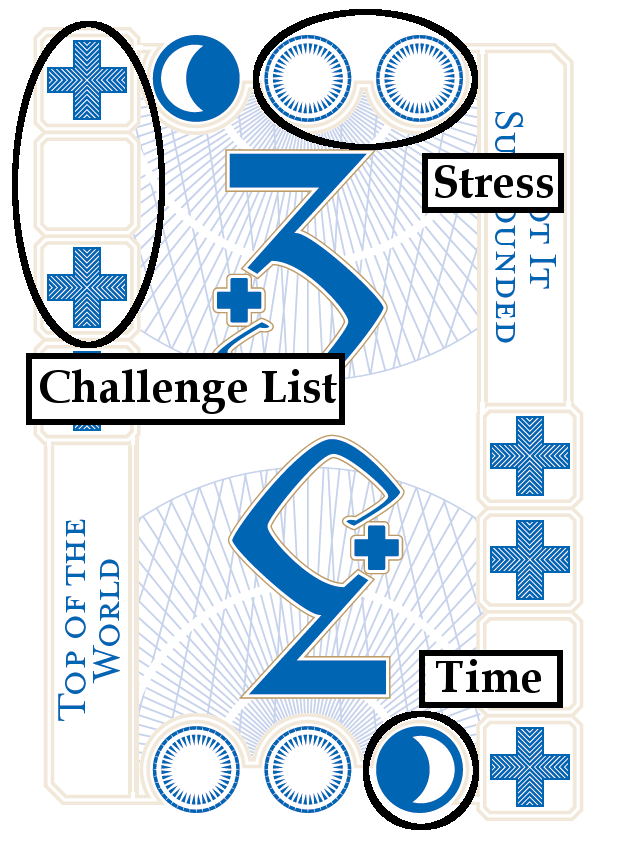
Mission (Boar's Hollow - Conquest Mission, Difficulty 5) : The relationship with Crescent Hold is slowly dwindling toward hostility. The Empire's efforts to discredit and misinform the populace of Crescent Hold are starting to bear fruit. Rather than address that souring diplomatic relationship, Thea made the decision to reach out to the farmers of Boar's Hollow in an effort to secure another food source for possible trade with Lily Manor. This wasn't a popular choice with Viator, who preferred a direct retaliation against the Empire by aiding the resistance within Southkeep.
Heroes taken on mission: Thea "Speaker for the East", Fuscus "Master of Coin", Viator "Courtier of Candlelight Keep"
The spotlight character is Thea. She made the difficult decision to focus on more resources rather than patching up things with Crescent Hold. Unfortunately, Thea still has a severe consequence, "Debt to Burgan Vale", which will no doubt make things more difficult. It's very likely the debt will rear it's ugly head during negotiations with Boar's Hollow.
Build Developments: No trade is possible with Crescent Hold, which will hurt the ability to gain ore. Luckily, Red Bank is fairly strong in ore reserves. Ideally, growing stronger in arcane or diplomatic developments is the highest priority.
Gained the Arcane Smith and Superb Casting. Very, very close to getting Superb Channeling - but settled for Arcane Smith instead. Still, most interested in pushing hard on the arcane track, which is happening. Would like to push on diplomacy some, but very constrained on luxuries and don't have a high enough relationship with Lily Manor to trade for them.
Challenge Phase: Thea, Fuscus, and Viator arrive in Boar's Hollow during a particularly brutal winter. Life is always difficult farming out in the hinterlands, but during blizzard conditions, it can be a struggle just to survive. It is in this context that Thea hopes to persuade the leaders of Boar's Hollow (Gerard, Hargeth, Leo, Gerda, and Talan) to join with Red Bank. Red Bank can provide both arcane and mechanical knowledge that will make life a little easier for the people of Boar's Hollow, in exchange for vegetables and grains.
Challenge Scene: Shoring Up Weakness - Diff 2, 3 Suns, Engineering / Wits : This scene triggered a complication for Thea. Given that Thea had some extra fate points left over from building developments, went ahead and paid it off. Particularly because there were no moons and it's a relatively easy challenge. I decided to use a hindering aspect, "A Brutal Honesty" from some magical robes Thea had. Then I drew a card with three moons! Talk about backfiring.
Thea spent time with Hargreth, looking at different architectural choices the people of Boar's Hollow had made. She spotted a number of serious problem areas. Rather than being tactful about rectifying them, she rather forcefully pointed out that they were not prepared for any conflicts. Her heritage with the Amber Hand came through, looking for military weakness. Hargreth was impressed with her knowledge, but less impressed with her tact.
Challenge Scene: Structural Weakness - Diff 6, 1 Moon, Command / Engineering : Fuscus and Thea spent a few weeks with Hargeth and Gerda going over plans. Finding support amongst the insular farmers was difficult. Fuscus used the power of the purse to help persuade Boar's Hollow to make changes.
Challenge Scene: New Friends - Diff 7, 2 Moons, Rapport / Society : Viator and Fuscus worked behind the scenes to gain the trust of Yula, a hedge magician friendly with Gerard. Viator employed magicks to help the duo achieve their goals. Having an ally close to Gerard, the ostensible leader of Boar's Hollow, could prove very useful.
Advantage Scene: An Apprentice : Viator spent more time continuing to mold Yula into a young apprentice worthy of his time. Yula was entranced by the prospect of working within Red Bank. A campaign aspect with two invokes was created, but it was immediately burned into an asset for Viator - "Yula, Hedge Magician from Boar's Hollow".
Conflict Phase (Diplomacy): Hargeth impressed upon Thea that he was concerned about cultural differences between Boar's Hollow and Red Bank (he managed to take the Culture issue). The envoys from Red Bank used their asset Yula to good effect in securing both Rule and Wrath - making sure Boar's Hollow understood what the Autarch was capable of and the benefits of joining together. In the end, Red Bank barely succeeded in taking three of the five issues.
Mission Status: Success! Boar's Hollow added to Sightrock.
Stability: Stronghold: -1
Ally Disposition: Burgan Vale +3, Crescent Hold -1 (dropped one), Gravewood -1, Lily Manor +2, Sunriders +2
Stronghold Developments:
Great Channeling
Great Casting
Superb Casting
Mana Forge
Trade Guild
Arcane Smith
Arcane Bowyer
Regional Income:
Obsidian Wood (Capital): 1 food, 2 timber, 2 mana
Echo Lake: 2 ore
Tarrydale Farms: 2 food
Boar's Hollow: 2 food, 1 ore
Green Vale: 1 food, 1 ore
Sightrock: 1 ore, 1 mana
---------------------------------------------------
Total: 6 food, 2 timber, 5 ore, 3 mana, 1 luxury
Schemes: Infiltration 1. The Autarch hatched the beginnings of an infiltration attack on the Stronghold. This will most likely be ignored during Spring of next year. There are more important things to focus on.
Scheme Pool
These are special dice pools used for the solo version of WotA.
Diplomacy Pool: 1
Infiltration Pool: 1 (Schemes: 1)
Skirmish Pool: 1 (Schemes: 1)
Warfare Pool: 1
Region Threats: Obsidian Wood (Diplomacy 5)
Ouch! This one hurts. Obsidian Wood is a source of many resouces for Red Bank. Most likely this will have to be dealt with. Going down to -2 stability would also be fairly dire.
Faction Threats: None
Rules Musings:
Everything leading up to the diplomacy conflict worked well (not surprising - that stuff hasn't really changed). The diplomacy conflict, though, felt a little off. The rules didn't change from the last diplomacy playtest, but the number of players did. Mapping types of symbols to actions works well when there are relatively few opponents to manage. However, it potentially generates double actions (such as one moon and perhaps two suns, etc). This is both kind of slow when there are lots of opponents as well as pretty swingy. I think for diplomacy it might be a more compact chart where there are actions based on the number of symbols (so three different action types). That will probably help things.
Saturday, April 15, 2017
Saturday, February 4, 2017
Red Bank Fall Y1 - Despair at Sightrock
Mission (Despair at Sightrock - Conquest Mission, Difficulty 4) : The Empire had begun pressuring the outer reaches of Red Bank, raiding different communities along the border. Resources were drained, resulting in a "Weapons are Stretched Thin" campaign aspect. Furthermore, Lily Manor's confidence in Red Bank eroded after they learned that Red Bank was interested in securing Thedda's Palimpsest from Burgan Vale.
Amidst this climate, the trio that tracked down the werewolf in the Spring headed out in the Fall to explore Sightrock. The advance force of farmers and crafters was succumbing to an intense depression and inability to work. Cyra suspected some manner of dweomer afflicting them.
Heroes taken on mission: Adula "Tracker of the Gray Wastes", Cyra "Alchemist of House Amber", Keel "Hobilar of the Amber Hand"
Adula was the spotlight character this time around. Her tracking and survival skills would be critical in mapping the region and discovering the sources of the discontent.
Build Developments: Built a broad number of developments: Trade Guilds, a Mana Forge, and an Arcane Bowyer.
Challenge Phase: The central feature of Sightrock is a large tower of stone visible from a great distance arround.
Challenge Scene: Secret Trails - Diff 2, 2 Suns, 1 Moon, Survival / Thievery : Adula and Keel paced the region in a deliberate fashion, looking for signs of activity. The Fall brought with it brutally cold winds. Dealing with the exposure took its toll on the duo, but they discovered suspicious patterns of tracks which entered and exited from around the North face of Sightrock.
Challenge Scene: On the Run - Diff 2, 2 Moons, Marksmanship : The blight on the land did not just affect humans, but animals as well. As the trio searched around the rock, looking for clues, they were set upon by a pack of foxes, swarming from many directions. This necessitated a controlled retreat toward the base of the rock, with Keel providing covering fire.
Challenge Scene: Avoiding Battle - Diff 3, 1 Sun, Disguise / Stealth : Pushed back towards the rock, the trio discovered an opening from which to hide from the beasts chasing them. Out of the frying pan into the fire! Within the passage, amidst dim torch light, Cyra found arcane runes hinting at the presence of old secrets long forgotten. Negotiating the passages required care and stealthy footwork - for whatever was here long ago laid many traps. As the group approached a deep space under the rock, Cyra became more concerned and fearful for what might lie below.
Advantage Scene: High Ground : Cyra moved into a wide open cavern with brackish water encircling a raised portion in the center. Her channeling allowed her to sense a presence in the water, a beast most foul and ancient. "Quickly, get to the high ground! Prepare your weapons!"
Conflict Phase (Skirmish): The Gray Spawn moved about the water quickly, looking for openings and attacking the weakest members of the group with hopelesseness and despair. Adula rushed forward, her powerful arms carrying a large sword toward the many slimy pseudopods whipping around in the dark. Keel rained down arrows at it, while Cyra cast down bolts of fire at any exposed areas.
Standing in front of the formless spawn of ancient magical energy took a tremendous toll on Adula. The creature focused a kind of cosmic blight upon her weak mortal consciousness. It was too much - Adula collapsed into the pool of muck, completely enervated. At the moment the beast was about to consumer her, Cyra managed to drain all of her magical reserves into one potent blast which roasted the thing. The magical backlash from casting such a powerful spell was almost more than Cyra could handle.
Mission Status: Success! Red Bank added Sightrock. Adula was completely full up on consequences, having been dropped by the formless spawn. It will take her quite a while to recover mentally from the brutal experience.
Stability: Stronghold: -1 (dropped one)
Ally Disposition: Burgan Vale +3, Crescent Hold +0, Gravewood -1, Lily Manor +2 (dropped one), Sunriders +2
Stronghold Developments:
Great Channeling
Great Casting
Mana Forge
Trade Guild
Arcane Bowyer
Regional Income:
Red Bank (Capital): 1 food, 2 timber, 2 mana
Echo Lake: 2 ore
Tarrydale Farms: 2 food
Green Vale: 1 food, 1 ore
Sightrock: 1 ore, 1 mana
---------------------------------------------------
Total: 4 food, 2 timber, 4 ore, 3 mana, 1 luxury
Schemes: None
Scheme Pool
These are special dice pools used for the solo version of WotA.
Diplomacy Pool: 1
Infiltration Pool: 1
Skirmish Pool: 1 (Schemes: 1)
Warfare Pool: 1
Region Threats: None
Faction Threats: Crescent Hold, Infiltration difficulty 6. The Empire is beginning a campaign of misinformation against Crescent Hold, subverting many of their core institutions. Given that relations with Crescent Hold are tenuous at best, this represens a disturbing development. Crescent Hold and Gravewood will probably not be reliable going forward.
Rules Musings:
The second skirmish playtest went much better than the first! The formless spawn had a mental attack that targeted a character's Will, which turned out to be really brutal considering none of the characters had high Will. May or may not be a problem - but it's always good to remember that creatures which target "secondary" sorts of defensive abilities may need to be scaled back a little bit.
Amidst this climate, the trio that tracked down the werewolf in the Spring headed out in the Fall to explore Sightrock. The advance force of farmers and crafters was succumbing to an intense depression and inability to work. Cyra suspected some manner of dweomer afflicting them.
Heroes taken on mission: Adula "Tracker of the Gray Wastes", Cyra "Alchemist of House Amber", Keel "Hobilar of the Amber Hand"
Adula was the spotlight character this time around. Her tracking and survival skills would be critical in mapping the region and discovering the sources of the discontent.
Build Developments: Built a broad number of developments: Trade Guilds, a Mana Forge, and an Arcane Bowyer.
Challenge Phase: The central feature of Sightrock is a large tower of stone visible from a great distance arround.
Challenge Scene: Secret Trails - Diff 2, 2 Suns, 1 Moon, Survival / Thievery : Adula and Keel paced the region in a deliberate fashion, looking for signs of activity. The Fall brought with it brutally cold winds. Dealing with the exposure took its toll on the duo, but they discovered suspicious patterns of tracks which entered and exited from around the North face of Sightrock.
Challenge Scene: On the Run - Diff 2, 2 Moons, Marksmanship : The blight on the land did not just affect humans, but animals as well. As the trio searched around the rock, looking for clues, they were set upon by a pack of foxes, swarming from many directions. This necessitated a controlled retreat toward the base of the rock, with Keel providing covering fire.
Challenge Scene: Avoiding Battle - Diff 3, 1 Sun, Disguise / Stealth : Pushed back towards the rock, the trio discovered an opening from which to hide from the beasts chasing them. Out of the frying pan into the fire! Within the passage, amidst dim torch light, Cyra found arcane runes hinting at the presence of old secrets long forgotten. Negotiating the passages required care and stealthy footwork - for whatever was here long ago laid many traps. As the group approached a deep space under the rock, Cyra became more concerned and fearful for what might lie below.
Advantage Scene: High Ground : Cyra moved into a wide open cavern with brackish water encircling a raised portion in the center. Her channeling allowed her to sense a presence in the water, a beast most foul and ancient. "Quickly, get to the high ground! Prepare your weapons!"
Conflict Phase (Skirmish): The Gray Spawn moved about the water quickly, looking for openings and attacking the weakest members of the group with hopelesseness and despair. Adula rushed forward, her powerful arms carrying a large sword toward the many slimy pseudopods whipping around in the dark. Keel rained down arrows at it, while Cyra cast down bolts of fire at any exposed areas.
Standing in front of the formless spawn of ancient magical energy took a tremendous toll on Adula. The creature focused a kind of cosmic blight upon her weak mortal consciousness. It was too much - Adula collapsed into the pool of muck, completely enervated. At the moment the beast was about to consumer her, Cyra managed to drain all of her magical reserves into one potent blast which roasted the thing. The magical backlash from casting such a powerful spell was almost more than Cyra could handle.
Mission Status: Success! Red Bank added Sightrock. Adula was completely full up on consequences, having been dropped by the formless spawn. It will take her quite a while to recover mentally from the brutal experience.
Stability: Stronghold: -1 (dropped one)
Ally Disposition: Burgan Vale +3, Crescent Hold +0, Gravewood -1, Lily Manor +2 (dropped one), Sunriders +2
Stronghold Developments:
Great Channeling
Great Casting
Mana Forge
Trade Guild
Arcane Bowyer
Regional Income:
Red Bank (Capital): 1 food, 2 timber, 2 mana
Echo Lake: 2 ore
Tarrydale Farms: 2 food
Green Vale: 1 food, 1 ore
Sightrock: 1 ore, 1 mana
---------------------------------------------------
Total: 4 food, 2 timber, 4 ore, 3 mana, 1 luxury
Schemes: None
Scheme Pool
These are special dice pools used for the solo version of WotA.
Diplomacy Pool: 1
Infiltration Pool: 1
Skirmish Pool: 1 (Schemes: 1)
Warfare Pool: 1
Region Threats: None
Faction Threats: Crescent Hold, Infiltration difficulty 6. The Empire is beginning a campaign of misinformation against Crescent Hold, subverting many of their core institutions. Given that relations with Crescent Hold are tenuous at best, this represens a disturbing development. Crescent Hold and Gravewood will probably not be reliable going forward.
Rules Musings:
The second skirmish playtest went much better than the first! The formless spawn had a mental attack that targeted a character's Will, which turned out to be really brutal considering none of the characters had high Will. May or may not be a problem - but it's always good to remember that creatures which target "secondary" sorts of defensive abilities may need to be scaled back a little bit.
Sunday, January 29, 2017
Red Bank Summer Y1 - Festival of Illusions
Mission (Festival of Illusions - Diplomacy Mission, Difficulty 4) : The Amber Hand raided Echo Lake, and the leadership of Red Bank chose to ignore the problem, letting the locals deal with it. This resulted in a loss of stability for Red Bank and a lack of goods coming from Echo Lake. Instead, Thea, Fuscus, and Viator headed out to Burgan Vale to find the location of Thedda's Palimpsest, the legendary book of arcane lore.
Part of this decision came from a desire to see diplomacy in action. But raising the disposition of Burgan Vale would be really nice as well.
Heroes taken on mission: Thea "Speaker for the East", Fuscus "Master of Coin", Viator "Courtier of Candlelight Keep"
The spotlight character was Fuscus. Fuscus had a connection within Burgan Vale: Childric, the washed up mercenary captain. Both Childric and Fuscus were from Southkeep. This would be a recurring theme for the mission.
Build Developments: Lacking the resources from Echo Lake made things difficult, but still managed to obtain Great Casting, thus unlocking the possibility for a Mana Forge in the fall.
Challenge Phase: Preparations for the Festival of Illusions, the annual celebration of magic in Burgan Vale, were underway. Thea took the opportunity to make contacts and meet up with old friends, while Fuscus and Viator undertook efforts to find information that could be used as leverage by Red Bank.
Challenge Scene: An Unseemly Past - Diff 5, 2 Suns, 1 Moon, Disguise / Thievery / Stealth : Fuscus and Childric did all sorts of morally questionable things on the streets of Southkeep when they were growing up. For insurance, Fuscus and Viator decided to dig some of this up on Childric. Playing innocent, asking around, and using some measure of deception let them find out that Childric didn't come to Burgan Vale under the most honest of circumstances. His past as an enforcer for the Empire was not something he wanted to get out. Should the situation arise, such information could prove useful.
Advantage Scene: Alda's Hopes and Dreams : While Fuscus and Viator were busy, Thea spent time with Alda, the horsemaster for Burgan Vale. She took the time to better understand and relate to Elisa's granddaughter on a more personal level. This culminated in the creation of a mission aspect with two free invokes.
Challenge Scene: Structural Weakness - Diff 3, 1 Moon, Engineering / Wits : In the tower of Arankh, Thea and Fuscus met with Marellus to go over security within Burgan Vale. Leveraging information from Fuscus' past, the duo exposed some weaknesses that the Autarch may be able to exploit. Marellus was grateful for their aid.
Challenge Scene: Bending Elisa's Ear - Diff 1, 1 Sun, 2 Moons, Society: After an initial difficult challenge, the rest of the scenes proved fairly easy. The final challenge scene showcased Thea following Elisa about while Elisa performed various preparation tasks for the festival. Thea took the opportunity to get closer to Elisa.
Advantage Scene: Favor of the Blue Robes: Finally, Fuscus and Viator worked to gain the favor of the Order of the Eye. With Viator's magical knowledge and Fuscus' charm, they were able to create a campaign aspect with two free invokes.
Conflict Phase (Diplomacy): The three envoys from Amber Hand worked carefully and methodically in addressing and discussing issues that came up for Burgan Vale. Marellus hammered on the history of Red Bank, the questionable relationship with the Amber Hand, and whether or not Red Hand could really be trusted with the knowledge of the Palimpsest. Elisa completely charmed Thea, using magic to put her in Burgan Vale's pocket for quite some time to come. Thea ended the conflict with both a moderate and a severe consequence reflecting this attraction to Elisa! In the end, the heroes narrowly completed three issues.
Mission Status: Success! Disposition with Burgan Vale increased by one. However, Red Bank had two campaign consequences with one free invoke each, Questionable Past and Watched by Elisa.
Stability: Stronghold: -1 (The raiders of the Amber Hand took their toll.)
Ally Disposition: Burgan Vale +3, Crescent Hold +0, Gravewood -1, Lily Manor +3, Sunriders +2
Stronghold Developments:
Great Channeling
Great Casting
Regional Income:
Red Bank (Capital): 1 food, 2 timber, 2 mana
Echo Lake: 2 ore
Tarrydale Farms: 2 food
Green Vale: 1 food, 1 ore
---------------------------------------------------
Total: 4 food, 3 timber, 4 ore, 2 mana, 1 luxury
Schemes: Skirmish One! The Autarch was causing problems on the frontier. Ignoring the scheme would mean a campaign aspect for the Autarch.
Scheme Pool
These are special dice pools used for the solo version of WotA.
Diplomacy Schemes: 1
Infiltration Schemes: 1
Skirmish Schemes: 1
Warfare Schemes: 1
Region Threats: None
Faction Threats: Lily Manor, Diplomacy difficulty 6. Lily Manor is nervous about the push toward gaining the Palimpsest. This worry could fester.
Rules Musings:
Used the same basic structure for diplomacy as was used for skirmish: each opponent has a chart which determines their action and the resulting total. It worked pretty well! It was difficult, probably on the border of being too difficult, but I enjoyed the fact it was kind of in doubt. It would be pretty fiddly if played solo, though. It's not as bad with a group if each player controls one of the opposing leaders as well. That kind of reduces the amount of info that's needed to track.
Also, it would be nice if the charts didn't need the character skill numbers at all. Currently, they do. That will make things a little redundant, but it's another way to be less fiddly. Used the complication and invoke rules tweaks from last session, and that went much better!
All in all, it worked fairly well. The biggest issue is probably going to be in terms of developing the info so that it's easy to track.
Next Session:
Not sure! Given how tough a difficulty 4 diplomacy mission was, the difficulty 6 mission to Lily Manor probably isn't going to happen. So that disposition is going to drop. And it doesn't really seem worth it to try to stop the Autarch's skirmish plans. Early on, they aren't that bad.
Most likely it will be an exploration mission to either Sunset Isles (diff 4) or the Gray Forest (diff 5). It would be good to ping-pong a few times between skirmish and diplomacy for playtest purposes, before moving on to infiltration and warfare. Probably choose Sunset Isles as Gray Forest looks pretty tough.
Part of this decision came from a desire to see diplomacy in action. But raising the disposition of Burgan Vale would be really nice as well.
Heroes taken on mission: Thea "Speaker for the East", Fuscus "Master of Coin", Viator "Courtier of Candlelight Keep"
The spotlight character was Fuscus. Fuscus had a connection within Burgan Vale: Childric, the washed up mercenary captain. Both Childric and Fuscus were from Southkeep. This would be a recurring theme for the mission.
Build Developments: Lacking the resources from Echo Lake made things difficult, but still managed to obtain Great Casting, thus unlocking the possibility for a Mana Forge in the fall.
Challenge Phase: Preparations for the Festival of Illusions, the annual celebration of magic in Burgan Vale, were underway. Thea took the opportunity to make contacts and meet up with old friends, while Fuscus and Viator undertook efforts to find information that could be used as leverage by Red Bank.
Challenge Scene: An Unseemly Past - Diff 5, 2 Suns, 1 Moon, Disguise / Thievery / Stealth : Fuscus and Childric did all sorts of morally questionable things on the streets of Southkeep when they were growing up. For insurance, Fuscus and Viator decided to dig some of this up on Childric. Playing innocent, asking around, and using some measure of deception let them find out that Childric didn't come to Burgan Vale under the most honest of circumstances. His past as an enforcer for the Empire was not something he wanted to get out. Should the situation arise, such information could prove useful.
Advantage Scene: Alda's Hopes and Dreams : While Fuscus and Viator were busy, Thea spent time with Alda, the horsemaster for Burgan Vale. She took the time to better understand and relate to Elisa's granddaughter on a more personal level. This culminated in the creation of a mission aspect with two free invokes.
Challenge Scene: Structural Weakness - Diff 3, 1 Moon, Engineering / Wits : In the tower of Arankh, Thea and Fuscus met with Marellus to go over security within Burgan Vale. Leveraging information from Fuscus' past, the duo exposed some weaknesses that the Autarch may be able to exploit. Marellus was grateful for their aid.
Challenge Scene: Bending Elisa's Ear - Diff 1, 1 Sun, 2 Moons, Society: After an initial difficult challenge, the rest of the scenes proved fairly easy. The final challenge scene showcased Thea following Elisa about while Elisa performed various preparation tasks for the festival. Thea took the opportunity to get closer to Elisa.
Advantage Scene: Favor of the Blue Robes: Finally, Fuscus and Viator worked to gain the favor of the Order of the Eye. With Viator's magical knowledge and Fuscus' charm, they were able to create a campaign aspect with two free invokes.
![]() |
| Diplomacy |
Mission Status: Success! Disposition with Burgan Vale increased by one. However, Red Bank had two campaign consequences with one free invoke each, Questionable Past and Watched by Elisa.
Stability: Stronghold: -1 (The raiders of the Amber Hand took their toll.)
Ally Disposition: Burgan Vale +3, Crescent Hold +0, Gravewood -1, Lily Manor +3, Sunriders +2
Stronghold Developments:
Great Channeling
Great Casting
Regional Income:
Red Bank (Capital): 1 food, 2 timber, 2 mana
Echo Lake: 2 ore
Tarrydale Farms: 2 food
Green Vale: 1 food, 1 ore
---------------------------------------------------
Total: 4 food, 3 timber, 4 ore, 2 mana, 1 luxury
Schemes: Skirmish One! The Autarch was causing problems on the frontier. Ignoring the scheme would mean a campaign aspect for the Autarch.
Scheme Pool
These are special dice pools used for the solo version of WotA.
Diplomacy Schemes: 1
Infiltration Schemes: 1
Skirmish Schemes: 1
Warfare Schemes: 1
Region Threats: None
Faction Threats: Lily Manor, Diplomacy difficulty 6. Lily Manor is nervous about the push toward gaining the Palimpsest. This worry could fester.
Rules Musings:
Used the same basic structure for diplomacy as was used for skirmish: each opponent has a chart which determines their action and the resulting total. It worked pretty well! It was difficult, probably on the border of being too difficult, but I enjoyed the fact it was kind of in doubt. It would be pretty fiddly if played solo, though. It's not as bad with a group if each player controls one of the opposing leaders as well. That kind of reduces the amount of info that's needed to track.
Also, it would be nice if the charts didn't need the character skill numbers at all. Currently, they do. That will make things a little redundant, but it's another way to be less fiddly. Used the complication and invoke rules tweaks from last session, and that went much better!
All in all, it worked fairly well. The biggest issue is probably going to be in terms of developing the info so that it's easy to track.
Next Session:
Not sure! Given how tough a difficulty 4 diplomacy mission was, the difficulty 6 mission to Lily Manor probably isn't going to happen. So that disposition is going to drop. And it doesn't really seem worth it to try to stop the Autarch's skirmish plans. Early on, they aren't that bad.
Most likely it will be an exploration mission to either Sunset Isles (diff 4) or the Gray Forest (diff 5). It would be good to ping-pong a few times between skirmish and diplomacy for playtest purposes, before moving on to infiltration and warfare. Probably choose Sunset Isles as Gray Forest looks pretty tough.
Sunday, January 15, 2017
Red Bank Spring Y1 - Werewolf of Hambridge Farms
Mission (The Werewolf of Hambridge Farms - Conquest Mission, Difficulty 4): For the first mission in the co-operative campaign I chose to help Green Vale with their werewolf problem. One of the easiest openings in WotA is to go after North Oaks, since the difficulty is only 3. But the food located in Green Vale makes it more attractive. I created some initial playtest rules to handle complications and invokes without an Autarch player, as well as rules to handle how the werewolf would move and attack.
Heroes taken on mission: Adula "Tracker of the Gray Wastes", Cyra "Alchemist of House Amber", Keel "Hobilar of the Amber Hand"
Although it's possible to play with only two characters, it's fairly difficult, so for this playtest Jennifer took on the roles of Cyra and Adula, while I played Keel. The spotlight player was Adula. This mission revolved around the young Cyra's growing realization that the world was much broader than her rather narrow form of schooling would lead to believe her. Adula was selected as the spotlight character since she knew more about the smaller farms and establishments surrounding Red Bank.
We talked for a while about how Red Bank is perceived in the world. There's a rift between the smaller hamlets and farms and the large technological hub within the capital. Cyra has been insulated inside this academic hub, studying magic and science and new forms of government. Keel comes from a time before this rapid progress. Keel is the classic veteran of many wars, coming as he did from the brutality of the Amber Hand. The tension between them was a big part of the mission. Somewhere in the center was the practical Adula, balancing both of their personalities with the need to finish the job at hand.
Build Developments: Rough rolling to start the campaign! But Red Haven finished work on Great Channeling. Which could come in handy given the number of spellcasters in Red Bank. Hopefully a Mana Forge is possible to build in the not too distant future.
Challenge Phase: The heroes made it to Hambridge Farms, the large agricultural center within the Green Vale. Hambridge Farms is run by Mila. The people of the farms have made token sacrifices to the werewolf as a way to appease it from making even worse attacks.
Challenge Scene: Over Hill and Under Hill - Diff 2, 2 Suns, 3 Moons, Survival / Thievery: Adula and Keel were in the first scene together. The card draw triggered a complication (suns higher than moons), which netted Adula another fate point, but made the scene more difficult by adding moons. As an initial way to handle complications in Autotarch, they occur whenever the suns are higher than moons. Adula charged ahead through cliffs and underbrush, ignoring demands for sleep and rest. The hunt took its toll on Adula and Keel. But they narrowed down how the werewolf moved about the farms.
Advantage Scene: Wolfsbane: Cyra took the opportunity to research Wolfsbane while Keel and Adula were out and about. She was successful, creating the Wolfsbane Oil mission aspect.
Challenge Scene: Animal Movement Patterns - Diff 1, 3 Suns, Survival / Thievery: With some research, Cyra ended up using the history of animal movement patterns to find holes in where they were located. Rather than wait for Adula and Keel, she charged off into the woods on her own to confirm her hypothesis. What she learned is that the woods are unforgiving, gaining the "Rocks Are Not Beds" consequence from gaining too much stress.
Challenge Scene: Amber Hand Raiders - Diff 7, 1 Sun, 2 Moons, Fighting / Marksmanship: Adula and Keel had drifted rather far away from Green Vale when Keel heard a familiar sound - the whistle of an attacking Amber Hand raiding party. The Amber Hand had never forgiven Keel for defecting and throwing his support in with Red Bank. Red Bank founders had used the Hand to secure territory and alliance, but then cut ties with them. Keel struggled with his feelings toward the Hand, but ultimately decided that they were not the path toward a brighter future. Many in the Amber Hand took this move as a betrayal, and Keel was now a wanted man.
The attackers were young, which gave Adula and Keel an advantage. Keel reacted quickly, dropping a sniper hidden in the trees and given Adula time to react. Adula bull rushed in - smashing one of the attackers and summarily dispatching another. The final few ran off. This would come back to bite the heros when threats were determined.
Advantage Scene: Angry Townsfolk: Jennifer decided to make a tactical choice by using a hindering aspect on one of Cyra's skills while she was creating advantage. This would almost certainly result in failure (and it did), but it gave Cyra two advances in Command. Coupled with the free one at the end of missions, this would be enough to raise Cyra's Command skill up.
Cyra decided to dismiss the folk wisdom of the local townsfolk in making her plans to deal with the werewolf. It was a city slicker vs. country bumpkin moment. In this case, the country bumpkins were onto something. Cyra decided to mess with the offerings to the werewolf, deciding they were of no benefit. Instead, this enraged the werewolf, causing it to attack in town. The Autotarch got the Endangered Farmers mission aspect with two free invokes. The farmers were going to be in the way during the final battle!
Conflict Phase (Skirmish): The werewolf could sense Cyra's weakness and stalked her relentlessly. Keel and Adula did a good job taking advantage of its aggressiveness, picking out openings and making it pay. Cyra also nailed it with a fairly potent fireball.
However, the werewolf took a pound of flash, pinning Cyra up against a wall and slashing her up. It was only the last second heroics of Adula that saved her. But Cyra still ended the mission with multiple consequences, both physical and stemming from her shaken confidence.
Mission Status: Success! Red Bank added Green Vale.
Stability: Stronghold: +0
Ally Disposition: Burgan Vale +2, Crescent Hold +0, Gravewood -1, Lily Manor +3, Sunriders +2
Stronghold Developments:
Great Channeling
Regional Income:
Red Bank (Capital): 1 food, 2 timber, 2 mana
Echo Lake: 2 ore
Tarrydale Farms: 2 food
Green Vale: 1 food, 1 ore
---------------------------------------------------
Total: 4 food, 3 timber, 4 ore, 2 mana, 1 luxury
Schemes: None
Scheme Pool
These are special dice pools used for the solo version of WotA.
Diplomacy Schemes: 1
Infiltration Schemes: 1
Skirmish Schemes: 1
Warfare Schemes: 1
Region Threats: Echo Lake regional threat, Skirmish difficulty 5. Attack of the Amber Hand raiders! We decided this threat would be the Amber Hand raiders coming back for more. Maybe they'll be recurring villains in this campaign?
Faction Threats: None
Rules Musings: Lots of stuff.
The Werewolf:
Overall, I think this session went pretty well. The werewolf was actually pretty fun. I created a chart to handle its behavior. The symbols on the Deck of Fate cards were used to determine the action type, while the value was its result (usually its result on the fighting check, possibly with a bonus based on the chart).
Kind of like:
...
Eclipse - Lycanthropy, move 4 and infect with lycanthropy (this was a special effect that basically gave the hero a really long term consequence)
3 Moons - Whirlwind Attack, move 5 toward zone with most characters, attack all with Fighting +2
2 Moons - Heightened Senses, move 5 toward character with lowest Athletics, attack with Fighting +1
1 Moon - Quick Attack, move 4 toward character with most physical stress, attack with Fighting
1 Sun - Powerful Attack, move 1 toward character with most physical stress, attack with Fighting +2
...
That sort of thing. If there were multiple symbols on a card (like 2 moons and 1 sun), the werewolf would do both, starting with the moons action. I have different "archetypes" for enemies, like tank, sneak, striker, that sort of thing. This fight went well. In fact, movement played a bigger role in this fight because the werewolf AI doesn't always do the optimal thing, which actually can make positioning matter a little more. It isn't easy to craft those charts, though, there's quite a bit of possibility to have really weird or boring interactions.
This kind of approach might be trickier with lots of minions. It might be one card draw determines the behavior of all of them at once. Drawing one card for every minion sounds like a pain.
Defense or Offense:
I kind of like the idea that the Autotarch never makes checks (the AI doesn't draw cards). So, on defense the werewolf will just have a target number. Drawing one card for the attack and one for defense is kind of a pain. With multiple players, drawing a card makes you feel like you have some agency. With one player, it's just extra fiddliness. And really, with the fate distribution, the only thing really happening is a pushing out of that bell curve. It makes it so that results like +6 or +7 are possible, since both cards are added.
Jenn didn't like the idea of drawing a card for the hero's defense, though. Since the werewolf wouldn't draw one for defense. I think it might be useful, though, because a card draw is a signifier to invoke aspects, etc. I don't think it's a big deal either way, but it could be when there are multiple opponents.
Invokes:
The Autotarch fate point spends didn't really work, though. I had this "trigger" thing where the Autotarch spends fate points in certain conditions. But the sequencing was hard to remember and untangle. I was hoping the AI wouldn't have to do invokes at all, but there's just too much in WotA that needs that ability. And one of my design goals is to keep as much the same on the player side as possible. I don't want to change how skills, stunts, core actions, developments, etc, work if I can help it.
So I'll have to do something a little more "dumb" but easy to remember. Like enemies invoke one aspect on their action during the conflict any time one is available, regardless. At least then they'll all get used, and it will be much easier to untangle and remember. Granted, there's always the chance an opponent does it at a really weird time that doesn't make sense. But the tables are much harder than the human controlled opponents, so that's how I'll balance it, I think.
Complications:
I also created an easy way to handle complications (any time the suns are higher than a moon when creating a scene). That worked well, I think, but there's some sequencing weirdness. A player creates a scene, draws a card, then when do players commit vs. when is there a complication? I think it works a little better if other heroes commit to the scene before the complication is determined. That makes it harder for the players, but I think it's a little bit better of a narrative flow. Again, not a big deal, but these are the sorts of rough edges that Autarch players usually handle which I didn't think about with Autotarch rules.
Heroes taken on mission: Adula "Tracker of the Gray Wastes", Cyra "Alchemist of House Amber", Keel "Hobilar of the Amber Hand"
Although it's possible to play with only two characters, it's fairly difficult, so for this playtest Jennifer took on the roles of Cyra and Adula, while I played Keel. The spotlight player was Adula. This mission revolved around the young Cyra's growing realization that the world was much broader than her rather narrow form of schooling would lead to believe her. Adula was selected as the spotlight character since she knew more about the smaller farms and establishments surrounding Red Bank.
We talked for a while about how Red Bank is perceived in the world. There's a rift between the smaller hamlets and farms and the large technological hub within the capital. Cyra has been insulated inside this academic hub, studying magic and science and new forms of government. Keel comes from a time before this rapid progress. Keel is the classic veteran of many wars, coming as he did from the brutality of the Amber Hand. The tension between them was a big part of the mission. Somewhere in the center was the practical Adula, balancing both of their personalities with the need to finish the job at hand.
Build Developments: Rough rolling to start the campaign! But Red Haven finished work on Great Channeling. Which could come in handy given the number of spellcasters in Red Bank. Hopefully a Mana Forge is possible to build in the not too distant future.
Challenge Phase: The heroes made it to Hambridge Farms, the large agricultural center within the Green Vale. Hambridge Farms is run by Mila. The people of the farms have made token sacrifices to the werewolf as a way to appease it from making even worse attacks.
Challenge Scene: Over Hill and Under Hill - Diff 2, 2 Suns, 3 Moons, Survival / Thievery: Adula and Keel were in the first scene together. The card draw triggered a complication (suns higher than moons), which netted Adula another fate point, but made the scene more difficult by adding moons. As an initial way to handle complications in Autotarch, they occur whenever the suns are higher than moons. Adula charged ahead through cliffs and underbrush, ignoring demands for sleep and rest. The hunt took its toll on Adula and Keel. But they narrowed down how the werewolf moved about the farms.
Advantage Scene: Wolfsbane: Cyra took the opportunity to research Wolfsbane while Keel and Adula were out and about. She was successful, creating the Wolfsbane Oil mission aspect.
Challenge Scene: Animal Movement Patterns - Diff 1, 3 Suns, Survival / Thievery: With some research, Cyra ended up using the history of animal movement patterns to find holes in where they were located. Rather than wait for Adula and Keel, she charged off into the woods on her own to confirm her hypothesis. What she learned is that the woods are unforgiving, gaining the "Rocks Are Not Beds" consequence from gaining too much stress.
Challenge Scene: Amber Hand Raiders - Diff 7, 1 Sun, 2 Moons, Fighting / Marksmanship: Adula and Keel had drifted rather far away from Green Vale when Keel heard a familiar sound - the whistle of an attacking Amber Hand raiding party. The Amber Hand had never forgiven Keel for defecting and throwing his support in with Red Bank. Red Bank founders had used the Hand to secure territory and alliance, but then cut ties with them. Keel struggled with his feelings toward the Hand, but ultimately decided that they were not the path toward a brighter future. Many in the Amber Hand took this move as a betrayal, and Keel was now a wanted man.
The attackers were young, which gave Adula and Keel an advantage. Keel reacted quickly, dropping a sniper hidden in the trees and given Adula time to react. Adula bull rushed in - smashing one of the attackers and summarily dispatching another. The final few ran off. This would come back to bite the heros when threats were determined.
Advantage Scene: Angry Townsfolk: Jennifer decided to make a tactical choice by using a hindering aspect on one of Cyra's skills while she was creating advantage. This would almost certainly result in failure (and it did), but it gave Cyra two advances in Command. Coupled with the free one at the end of missions, this would be enough to raise Cyra's Command skill up.
Cyra decided to dismiss the folk wisdom of the local townsfolk in making her plans to deal with the werewolf. It was a city slicker vs. country bumpkin moment. In this case, the country bumpkins were onto something. Cyra decided to mess with the offerings to the werewolf, deciding they were of no benefit. Instead, this enraged the werewolf, causing it to attack in town. The Autotarch got the Endangered Farmers mission aspect with two free invokes. The farmers were going to be in the way during the final battle!
Conflict Phase (Skirmish): The werewolf could sense Cyra's weakness and stalked her relentlessly. Keel and Adula did a good job taking advantage of its aggressiveness, picking out openings and making it pay. Cyra also nailed it with a fairly potent fireball.
However, the werewolf took a pound of flash, pinning Cyra up against a wall and slashing her up. It was only the last second heroics of Adula that saved her. But Cyra still ended the mission with multiple consequences, both physical and stemming from her shaken confidence.
Mission Status: Success! Red Bank added Green Vale.
Stability: Stronghold: +0
Ally Disposition: Burgan Vale +2, Crescent Hold +0, Gravewood -1, Lily Manor +3, Sunriders +2
Stronghold Developments:
Great Channeling
Regional Income:
Red Bank (Capital): 1 food, 2 timber, 2 mana
Echo Lake: 2 ore
Tarrydale Farms: 2 food
Green Vale: 1 food, 1 ore
---------------------------------------------------
Total: 4 food, 3 timber, 4 ore, 2 mana, 1 luxury
Schemes: None
Scheme Pool
These are special dice pools used for the solo version of WotA.
Diplomacy Schemes: 1
Infiltration Schemes: 1
Skirmish Schemes: 1
Warfare Schemes: 1
Region Threats: Echo Lake regional threat, Skirmish difficulty 5. Attack of the Amber Hand raiders! We decided this threat would be the Amber Hand raiders coming back for more. Maybe they'll be recurring villains in this campaign?
Faction Threats: None
Rules Musings: Lots of stuff.
The Werewolf:
Overall, I think this session went pretty well. The werewolf was actually pretty fun. I created a chart to handle its behavior. The symbols on the Deck of Fate cards were used to determine the action type, while the value was its result (usually its result on the fighting check, possibly with a bonus based on the chart).
Kind of like:
...
Eclipse - Lycanthropy, move 4 and infect with lycanthropy (this was a special effect that basically gave the hero a really long term consequence)
3 Moons - Whirlwind Attack, move 5 toward zone with most characters, attack all with Fighting +2
2 Moons - Heightened Senses, move 5 toward character with lowest Athletics, attack with Fighting +1
1 Moon - Quick Attack, move 4 toward character with most physical stress, attack with Fighting
1 Sun - Powerful Attack, move 1 toward character with most physical stress, attack with Fighting +2
...
That sort of thing. If there were multiple symbols on a card (like 2 moons and 1 sun), the werewolf would do both, starting with the moons action. I have different "archetypes" for enemies, like tank, sneak, striker, that sort of thing. This fight went well. In fact, movement played a bigger role in this fight because the werewolf AI doesn't always do the optimal thing, which actually can make positioning matter a little more. It isn't easy to craft those charts, though, there's quite a bit of possibility to have really weird or boring interactions.
This kind of approach might be trickier with lots of minions. It might be one card draw determines the behavior of all of them at once. Drawing one card for every minion sounds like a pain.
Defense or Offense:
I kind of like the idea that the Autotarch never makes checks (the AI doesn't draw cards). So, on defense the werewolf will just have a target number. Drawing one card for the attack and one for defense is kind of a pain. With multiple players, drawing a card makes you feel like you have some agency. With one player, it's just extra fiddliness. And really, with the fate distribution, the only thing really happening is a pushing out of that bell curve. It makes it so that results like +6 or +7 are possible, since both cards are added.
Jenn didn't like the idea of drawing a card for the hero's defense, though. Since the werewolf wouldn't draw one for defense. I think it might be useful, though, because a card draw is a signifier to invoke aspects, etc. I don't think it's a big deal either way, but it could be when there are multiple opponents.
Invokes:
The Autotarch fate point spends didn't really work, though. I had this "trigger" thing where the Autotarch spends fate points in certain conditions. But the sequencing was hard to remember and untangle. I was hoping the AI wouldn't have to do invokes at all, but there's just too much in WotA that needs that ability. And one of my design goals is to keep as much the same on the player side as possible. I don't want to change how skills, stunts, core actions, developments, etc, work if I can help it.
So I'll have to do something a little more "dumb" but easy to remember. Like enemies invoke one aspect on their action during the conflict any time one is available, regardless. At least then they'll all get used, and it will be much easier to untangle and remember. Granted, there's always the chance an opponent does it at a really weird time that doesn't make sense. But the tables are much harder than the human controlled opponents, so that's how I'll balance it, I think.
Complications:
I also created an easy way to handle complications (any time the suns are higher than a moon when creating a scene). That worked well, I think, but there's some sequencing weirdness. A player creates a scene, draws a card, then when do players commit vs. when is there a complication? I think it works a little better if other heroes commit to the scene before the complication is determined. That makes it harder for the players, but I think it's a little bit better of a narrative flow. Again, not a big deal, but these are the sorts of rough edges that Autarch players usually handle which I didn't think about with Autotarch rules.
Friday, January 13, 2017
Red Bank Stronghold Creation
I'm currently working on developing Autotarch: solo and co-operative rules for Wrath of the Autarch. As part of that design process, I'm going to run through a new campaign! My hope is that I'll be able to design the rules iteratively, adding and tweaking rules before each session.
I created a broad stable of characters for this campaign, rather than adopting a more focused strategy. I'd like to see many different types of missions play out, so breadth was more important than depth. I have a rough idea for a Stronghold and a starting set of characters. I like starting a little sketchy, and filling out ideas as the campaign goes along.
Along with the narrative details of the unfolding campaign, I'm also going to use this forum to go into some detail about various mechanical options that I'm weighing. I'll put that information at the end of the different session posts.
Red Bank
I like the idea of creating a strong trading capital, something to rival Lily Manor. It is fairly cosmopolitan. There's a little double entendre in the name. Red Bank is both a monetary hub as well as being situated on a wide, winding river.
Wrath: Interest is Owed
There's a dark history buried in Red Bank's past. The founders of Red Bank borrowed significant funds and resources from the current Autarch's grandfather to start this new colony. Contracts were signed and agreed upon to pay these funds back. Due to a growing cultural rift, there is no political will to make these payments. So they have stopped. The Empire will not abide by that decision.
Belief: Keepers of True Lore
The people of Red Bank feel like they hold keys to knowledge which would be lost under Imperial rule. Large libraries adorn the city proper. Protecting this hard gained knowledge is a common rallying cry within Red Bank.
Culture: Duality of Atom and Void
There are many sects within Red Bank that value empirical inquiry. This inquiry has been codified and adopted into cultural norms that ripple outward: a rejection of determinism and the adoption of scholarly hedonism. This puts Red Bank closer ideologically to Lily Manor than the Empire.
History: Riders of the Amber Hand
All was not always scholarship and republicanism. Prior to founding Red Bank, most of the inhabitants in the area were members of a vicious warband known as the Amber Hand. There is still an affinity toward the legacy of mounted warfare handed down from those founders. This is also part of the dark past of Red Bank: it is a city founded on violence and theft.
Rule: Elevenfold Conclave
Different subject matter experts are elected throughout the populace to serve on a broad council which makes most of the policy decisions. The process of election varies, and is frequently plagued by corruption and graft, but many of the leaders are competent and have thus far guided Red Bank to rapid success.
Faction Dispositions
Note: rather than have two factions starting with disposition, I'm going to have one of them start at -1. This will make things a little harder, but that's going to be necessary in general in the co-op version.
Lily Manor: 3
Burgan Vale: 2
Sunriders: 1
Crescent Hold: 0
Gravewood: -1
Heroes
For now, I'm just coming up with a core concept and the top few skills. The rest will get fleshed out over the course of the campaign. There is quite a bit of magic in this set of characters, so getting mana will be useful.
Adula - Tracker of the Gray Wastes (Fighting, Engineering)
Viator - Courtier of Candlelight Keep (Secrets of the Mind, Lore, Thievery)
Cyra - Alchemist of House Amber (Secrets of the Elements, Lore, Tactics)
Arilde - Hawkleader of the Ghost Legion (Command, Fighting)
Yasmina - Keeper of Natural Lore (Secrets of the Wild, Lore, Stealth)
Keel - Hobilar of the Amber Hand (Marksmanship, Stealth)
Thea - Speaker for the East (Society, Command)
Oniri - The Last Necromancer (Secrets of the Dead, Lore, Command)
Fuscus - Master of Coin (Rapport, Disguise)
Lucia - Youngest Daughter of the Guild of Secrets (Thievery, Rapport)
I created a broad stable of characters for this campaign, rather than adopting a more focused strategy. I'd like to see many different types of missions play out, so breadth was more important than depth. I have a rough idea for a Stronghold and a starting set of characters. I like starting a little sketchy, and filling out ideas as the campaign goes along.
Along with the narrative details of the unfolding campaign, I'm also going to use this forum to go into some detail about various mechanical options that I'm weighing. I'll put that information at the end of the different session posts.
Red Bank
I like the idea of creating a strong trading capital, something to rival Lily Manor. It is fairly cosmopolitan. There's a little double entendre in the name. Red Bank is both a monetary hub as well as being situated on a wide, winding river.
Wrath: Interest is Owed
There's a dark history buried in Red Bank's past. The founders of Red Bank borrowed significant funds and resources from the current Autarch's grandfather to start this new colony. Contracts were signed and agreed upon to pay these funds back. Due to a growing cultural rift, there is no political will to make these payments. So they have stopped. The Empire will not abide by that decision.
Belief: Keepers of True Lore
The people of Red Bank feel like they hold keys to knowledge which would be lost under Imperial rule. Large libraries adorn the city proper. Protecting this hard gained knowledge is a common rallying cry within Red Bank.
Culture: Duality of Atom and Void
There are many sects within Red Bank that value empirical inquiry. This inquiry has been codified and adopted into cultural norms that ripple outward: a rejection of determinism and the adoption of scholarly hedonism. This puts Red Bank closer ideologically to Lily Manor than the Empire.
History: Riders of the Amber Hand
All was not always scholarship and republicanism. Prior to founding Red Bank, most of the inhabitants in the area were members of a vicious warband known as the Amber Hand. There is still an affinity toward the legacy of mounted warfare handed down from those founders. This is also part of the dark past of Red Bank: it is a city founded on violence and theft.
Rule: Elevenfold Conclave
Different subject matter experts are elected throughout the populace to serve on a broad council which makes most of the policy decisions. The process of election varies, and is frequently plagued by corruption and graft, but many of the leaders are competent and have thus far guided Red Bank to rapid success.
Faction Dispositions
Note: rather than have two factions starting with disposition, I'm going to have one of them start at -1. This will make things a little harder, but that's going to be necessary in general in the co-op version.
Lily Manor: 3
Burgan Vale: 2
Sunriders: 1
Crescent Hold: 0
Gravewood: -1
Heroes
For now, I'm just coming up with a core concept and the top few skills. The rest will get fleshed out over the course of the campaign. There is quite a bit of magic in this set of characters, so getting mana will be useful.
Adula - Tracker of the Gray Wastes (Fighting, Engineering)
Viator - Courtier of Candlelight Keep (Secrets of the Mind, Lore, Thievery)
Cyra - Alchemist of House Amber (Secrets of the Elements, Lore, Tactics)
Arilde - Hawkleader of the Ghost Legion (Command, Fighting)
Yasmina - Keeper of Natural Lore (Secrets of the Wild, Lore, Stealth)
Keel - Hobilar of the Amber Hand (Marksmanship, Stealth)
Thea - Speaker for the East (Society, Command)
Oniri - The Last Necromancer (Secrets of the Dead, Lore, Command)
Fuscus - Master of Coin (Rapport, Disguise)
Lucia - Youngest Daughter of the Guild of Secrets (Thievery, Rapport)
Tuesday, October 6, 2015
WotA Tutorial 3: Campaign Aspects and Reincorporation
Now that the Wrath of the Autarch kickstarter is in full swing, I thought I would discuss some other aspects (heh) of the kingdom building game that might be of interest to Fate Core players. In particular, how Wrath of the Autarch handles aspects that have impact at different timescales.
If you haven't heard of Wrath of the Autarch, check out the kickstarter here: https://www.kickstarter.com/projects/295104591/wrath-of-the-autarch-a-kingdom-building-game
Wrath of the Autarch has aspects which occur at three distinct timescales: minor advantages, mission aspects, and campaign aspects. As well as having varying timescales, the longer lived aspects typically have a more central role in the campaign.
If you haven't heard of Wrath of the Autarch, check out the kickstarter here: https://www.kickstarter.com/projects/295104591/wrath-of-the-autarch-a-kingdom-building-game
Aspects at Different Timescales
![]() |
| A Sunrider Visits Her Clan's Ovoo |
- Minor Advantages - These are very short lived transient aspects, similar to boosts. They can be created as an action during either the challenge phase or the final conflict. Usually, minor advantages are not written down. Furthermore, they don't last beyond the end of the creating player's next turn.
- Flanked, Embarrassed, Hidden
- Mission Aspect - Mission aspects are created during the challenge phase as an action. They last until the end of the current mission (the end of the season). As such, they tend to be harder to create. Mission aspects are usually created during the challenge phase for use during the conflict.
- Wolfsbane, Heinrich's Password Convention, Curio for the Prince
- Campaign Aspect - Campaign aspects are created during the challenge phase as an action. They're written down on the Stronghold sheet and last the entire campaign (or until they're no longer applicable).
- Sword of Kynian, Contact within Autarch's Spy Network, Angry Hearts in Burgan Vale
Create Advantage as Scene Creation
Creating mission and campaign aspects is a bigger deal than creating minor advantages. These aspects can't be created during a conflict and can't be created if a character is in a challenge scene. Instead, the creation of these sorts of aspects is handled as their own scene. The Stronghold player who wishes to create the aspect sets the scene on their turn, then uses the appropriate skill to see if they're successful.
The opposition for creating mission aspects is equal to the difficulty of the mission. The opposition for creating campaign aspects is two higher than the mission.
Example: Rebecca is playing Varys, the silver tongued sorcerer from Aben's Hollow. He is deep within the Imperial library at Northkeep, looking for a particular book of Secrets. "Varys is trying to find the Whispers of Kynian, famed for revealing the secrets of the mind. I'd like to create a campaign aspect."
The mission difficulty is 4, so the opposition to create a campaign aspect is 6. Varys is using his Lore skill, which is 5. Rebecca gets a +2 on the check, success! She writes down the aspect Whispers of Kynian on the Stronghold sheet with one free invoke.
The opposition for creating mission aspects is equal to the difficulty of the mission. The opposition for creating campaign aspects is two higher than the mission.
Example: Rebecca is playing Varys, the silver tongued sorcerer from Aben's Hollow. He is deep within the Imperial library at Northkeep, looking for a particular book of Secrets. "Varys is trying to find the Whispers of Kynian, famed for revealing the secrets of the mind. I'd like to create a campaign aspect."
The mission difficulty is 4, so the opposition to create a campaign aspect is 6. Varys is using his Lore skill, which is 5. Rebecca gets a +2 on the check, success! She writes down the aspect Whispers of Kynian on the Stronghold sheet with one free invoke.
Reincorporating Campaign Aspects
By virtue of writing these aspects down on the Stronghold sheet, they become reincorporated over the course of the campaign. This is a particularly nice feature for Wrath of the Autarch given that there is no gamemaster. Typically, reincorporation of thematic content is one of those elements that gets forgotten without one strong driving force. By writing campaign aspects down they become important and explicit.
The Autarch player also sometimes is able to create campaign aspects to reflect negative situations - such as Angry Hearts in Burgan Vale. During a related mission, the Stronghold players could attempt to deal with this as an overcome action.
Labels:
challenge scenes,
Fate Fractal,
Wrath of the Autarch
Friday, February 20, 2015
WotA Tutorial 2: Challenge Scenes
Challenge Scenes
During the challenge phase, the players work together to craft challenge scenes that drive towards a climactic conflict (the conflict is the final part of the mission). The Autarch player may add additional complications to challenge scenes - making them more difficult to resolve. The players need to complete one challenge per Stronghold player, and they only have three exchanges to do it! Failing to do so in the given time gives the Autarch player additional fate points for the conflict. The challenge phase is also an opportunity for the Stronghold players to make longer term plans in the form of campaign aspects.The Stronghold players each take one of two actions during the challenge phase: resolving a challenge scene (Overcome) or creating aspects (Create Advantage). Wrath of the Autarch uses three types of aspects: minor advantage, mission, and campaign. The challenge phase is the only time mission and campaign aspects may be created. Creating mission and campaign aspects may only be done when heroes aren't in challenge scenes (creating mission and campaign aspects involve short scenes of their own).
Conquering North Oaks
For this example, Steingrimr the Noble Barbarian, Aine the Headstrong Ranger, and Arild the Hollow Eyed Assassin are attempting to wrest the neutral region North Oaks from the necromancer Malthias. This is a Conquest (Skirmish) mission with a difficulty of 3 - fairly easy as these things go. Let's go through one exchange of action! Each Stronghold player takes a turn in any order they wish.
Creating a Scene
If a hero isn't already in a challenge scene, they may create a new scene as part of their action. Aaron, playing Steingrimr, decides to create a scene. A fate card is drawn and used to create the scene.
![]() |
| Creating a Challenge Scene |
A challenge scene is composed of:
- A difficulty (the result of the card plus the mission difficulty)
- Allowable skills for resolving the scene (found by looking at the appropriate Challenge list)
- (Sometimes) Stress taken when resolving the scene (suns)
- (Sometimes) Additional time needed to resolve the scene (moons)
- Heroes in the scene
![]() |
| Challenge Scene Details |
The difficulty of this scene is 6 (mission difficulty of 3 plus 3 more for the result on the card) - not very easy! The two suns and one moon indicate it's both stressful and time consuming. Aaron decides that the scene involves a bone golem Malthias' has constructed chasing the heroes through the dense woods. The giant beast is chasing them from their encampment, attacking with a massive club, bashing tree limbs and hero limbs along the way. The heroes are attempting a controlled withdrawal, trying to escape the beast.
Since Aaron drew the card, Steingrimr must be in the scene. The other characters may be in the scene at their option. Heroes in a challenge scene may not create mission or campaign aspects (only minor advantage may be created while in a challenge scene), so occasionally it's worth not joining in a scene. However, this is an all hands on deck situation, so both Aine and Arild are with Steingrimr!
Steingrimr Attacks (Resolve Challenge)
It's Aaron's turn (he drew the card). He may either create an advantage or try to resolve the challenge. The moons must be removed before the challenge may be successfully completed. The opposition for this task is equal to the number of moons (one). Usually this is easier, but it makes the scene take longer.
Steingrimr is a warrior, with a Fighting of +4. Aaron decides to try to remove one of the moons using the Resolve Challenge (Overcome) action rather than creating an advantage. He gets a -2 - for a total of +2, success!
Additionally, every time the resolve challenge action is taken, the hero takes all of the suns on the card as physical or mental stress (up to the player). Steingrimr waits behind a tree, lunging out and smashing the beast! It hits him back, Aaron marks the second box on Steingrimr's physical stress (from the two suns). This buys the group more time to retreat, but the beast takes its toll!
Aine Provides Cover Fire (Create Advantage)
Aine's player, Shawn, decides to lay down defensive fire to buy time for Arild to find shelter from the beast. This takes the form of a Create Advantage action. Only minor advantages may be created while in a challenge scene. Furthermore, only other characters in the same scene may utilize these minor advantages. The difficulty to create a minor advantage is two less than the mission difficulty (in this example a mere +1, since the mission difficulty is 3).
Shawn decides to use Marksmanship to create an advantage. Any appropriate skill may be used for the creation of advantages. Skills used for resolving a challenge are restricted to those on the challenge list (in this case Fighting and Survival). Aine's Marksmanship is +4, and Shawn gets a result of +1 for a total of +5. Success with style!
Shawn creates the aspect Covering Fire, giving it two free invokes from success with style.
Arild Finds Shelter (Resolve Challenge)
Finally, Arild must take an action. With the two free invokes, Geoff, Arild's player, decides that Survival might be a good way to find a path out of these woods and away from the bone golem. The difficulty is +6 to resolve the challenge scene. Not so easy, but armed with the free invokes from covering fire, Arild has a much better chance of success.
Arild's Survival is +3. Geoff initially gets a -3, ouch! Using one of the free invokes, Geoff re-draws, getting a +2, much better! The total is now +5. Using the other free invoke to add +2 to the result, the result is +7, success! However, Arild must take two stress from the two suns on the challenge scene from using the Resolve Challenge action. Geoff marks off the second box on Arild's mental stress track.
Also, because the difficulty of the opposition was higher than Arild's Survival skill, Geoff may mark off one skill advance box for Survival. When a character has three skill advances they may improve their skill rank. Skills only advance this way during the challenge scene, not during the conflict.
While Aine keeps the beast at bay, Arild studies the landscape carefully. His trained eyes spot a narrow cave entrance on the side of a hill. The heroes rush towards it, escaping the beast! Geoff marks off Arild's second mental stress box (from the two suns) - the close call impacted Arild's nerves!
Labels:
challenge scenes,
Tutorial,
Wrath of the Autarch
Friday, January 16, 2015
WotA Tutorial 1: Trading for Fun and Profit
This is the first in a series of posts designed to highlight the kingdom building game Wrath of the Autarch through examples of play. For a general overview of Wrath of the Autarch, see here: http://grue-fodder.blogspot.com/2014/06/what-is-wrath-of-autarch.html
The beta rules can be found here: https://sites.google.com/site/frontiergamedesign505
The first part of every session is dedicated to Stronghold Upkeep: applying ignored threats, gathering resources, trading with other factions, feeding the population, and building developments. Developments are sort of like stunts for the Stronghold. They may improve the Stronghold's ability to wage war or they might grant access to better resources for all of the heroes associated with the Stronghold. This tutorial focuses on the process of getting resources and using them to build developments.
The beta rules can be found here: https://sites.google.com/site/frontiergamedesign505
Stronghold Upkeep
Hope Springs Eternal
It is the Spring of Year 3. The Stronghold of Aben's Hollow plans an Alliance mission to visit the Gravewood, their ally, beseeching them for aid in the coming battle with the Empire. Luckily, there were no threats at the end of last season, so all their regions are available to them. Aben's Hollow controls the following regions:
- Obsidian Wood - 1 food, 2 timber, 2 mana
- Echo Lake - 2 ore, 1 luxury
- Tarrydale Farms - 2 food
- Green Vale - 1 food, 1 ore
- North Oaks - 1 timber
- Totals: 4 food, 3 timber, 3 ore, 2 mana, 1 luxury
A Fickle Harvest
The first step is to gather six sided dice for each available resource. It's easiest to use different colors of dice for each type of resource.
![]() |
| Gather resource dice: 4 Food, 3 Timber, 3 Ore, 2 Mana, 1 Luxury |
After all the dice are gathered, they are rolled by the spotlight player to determine the specific amounts of each resource available. Rolling the dice represents all the fickle supply issues that can impact seasonal harvest and usage. Each session a different spotlight player is featured. (The spotlight player has additional importance besides managing resources for the session.)
![]() |
| Roll dice: Food: 5,3,3,2 Timber: 4,2,1 Ore: 2,2,2 Mana: 5,3 Luxury: 3 |
Tactical or Strategic Development Building
Each development has resources requirements and possibly other developments that must be built first. When building a development whole dice must be assigned to reach the resource total. The values on the rolled dice may not be split up.
It's best to look at what developments are desired, and then decide whether to get the one that is really desired (thinking strategically) or try to optimize the rolled dice to get as much as possible (thinking tactically).
For the current mission Aben's Hollow is on (Alliance), either Trade Relationships or Arts and Entertainment would be nice. They could also prove useful in the future as well. Another really nice development that Aben's Hollow wants is the Mana Forge given they have lots of spellcasters associated with the Stronghold.
Unfortunately, Aben's Hollow only has 3 luxuries total, which is too low for either of these. They also only have 7 timber, which is too low for Arts and Entertainment.
Mana Forge is available and useful. Most likely they could get this and something else.
For the current mission Aben's Hollow is on (Alliance), either Trade Relationships or Arts and Entertainment would be nice. They could also prove useful in the future as well. Another really nice development that Aben's Hollow wants is the Mana Forge given they have lots of spellcasters associated with the Stronghold.
![]() |
| Aben's Hollow doesn't have enough luxuries to get either of these |
![]() |
| Aben's Hollow could pick this one up |
Wheeling and Dealing
What to do if you want more resources? Trade! There are five minor factions in the game, and they each desire and give different resource dice. The particulars of the trade are based on the disposition with the faction. Disposition ranges from -6 to +6. The higher the disposition, the better allies they are and the better the trades are going to be. (High disposition also might allow access to military units and powerful artifacts from the faction.)
Aben's Hollow has the following dispositions with minor factions:
- Gravewood: 2
- 1 luxury die for 2 timber dice
- Sunriders: 3
- 2 mana dice for 3 food dice or
- 1 mana die for 1 food die
- Lily Manor: 1
- 2 food dice for 1 luxury die
The Stronghold may trade with each minor faction only once each season, by placing the number of required dice onto the faction trading chart, and taking the number of dice of the appropriate type. The dice given by the faction are rolled immediately and added to the pool of dice. There is a strategy in trading away the lower valued dice and using the resources the faction gives back to build developments that couldn't otherwise be built.
Aben's Hollow could get a luxury dice from Lily Manor that could be used to build the Trade Relationships development. They'll need a little luck, though, needing to roll a 4 on the dice they get to reach a total of 7.
Before they do that, though, they could take their mana dice (either 1 or both) and trade them with the Sunriders to get more food dice. That would mean no Mana Forge, though, because they wouldn't have enough mana. But those food dice would give more options when trading with Lily Manor - wheels of commerce spin!
![]() |
| Give two mana dice to get three food dice |
Instead of trading 2 mana for 3 food, Aben's Hollow could also trade 1 mana for 1 food. It's not as good of a rate, though, and it doesn't look like the single mana die will be useful for anything.
![]() |
| New food dice are rolled (5,2,1), mana dice are gone |
The dice are rolled: 5,2,1. Not great. The 2 and 1 food die are traded to Lily Manor for 1 more luxury die. This is rolled and... 4! Trade Relationships is now possible to get!
![]() |
| Allocated resources for Trade Relationships |
All that remains are food dice - 5,5,3,3,2.
The Power of a Luxury Based Economy
One other use for luxuries - they can be spent to re-roll any of one type of resource die. There aren't any left over after this, but this is a powerful use for luxuries. Luxuries are hard to come by!
Feeding the Masses
Finally, an amount of food equal to twice the number of regions must be spent to feed the people.
Aben's Hollow controls 5 regions, so they'll need to allocate 10 food or suffer stability loss. Luckily, they can put the two 5 dice and exactly meet the requirement, with the 3,3,2 food dice left over!
Leftover Resources for Spotlight Fate Points
Two resource dice may be spent to give the spotlight player an additional fate point to start the mission.
Aben's Hollow is left with three dice. Two of those could be used to give the Spotlight Player one additional fate point for this mission. Alternatively, an infantry unit could be mustered for 6 food. The Spotlight Player decides it would be better to muster an additional unit rather than get one fate point.
Labels:
Stronghold Upkeep,
Tutorial,
Wrath of the Autarch
Wednesday, August 6, 2014
Campaign Frame Thoughts
Currently the campaign ends when the stability of either the Stronghold or the Empire drops down to zero. There's also a way for the Stronghold to end the campaign by assassinating the Autarch. I had in mind that there would be some sort of attack by the Autarch afterward.
Ultimately, what I'm interested in is a session that feels like a true finale. Thus, basing the whole campaign around stability may not be the best approach. It makes stability very important in terms of winning, but if it directly impacts how easy it is to win a mission, then the win condition and the resource needed for success are tied together, which isn't a great design choice.
Thinking about the mission types and how they might function in winning, there are:
Stronghold Victory Paths
Warfare - Attacking the Empire's capital wins the game for the Stronghold. This seems like a suitable finale for the campaign. It's really hard to do (capitals can be defended with more units, and the Autarch has a castle there). It will probably happen suitably far in, so the Autarch would be featured in the defense of the capital.
Infiltration - Assassinating the Autarch is another way to win. This is a difficult mission as well. It doesn't feel quite as nice of a resolution, because the Autarch wouldn't be able to defend directly as easily. However, it's so difficult, that it would be something that also would tend to happen far into the campaign.
Autarch Victory Paths
Warfare - Similar to the Stronghold, the Empire can win by attacking the Stronghold's capital. For all the reasons it's difficult for the Stronghold, it's difficult for the Empire.
Skirmish? - The Empire uses Skirmish instead of Infiltration to assassinate heroes. Unlike for the Autarch, though, a hero could get assassinated and the campaign could continue on. Of course, if enough heroes get assassinated, it's functionally over.
Wrath of the Autarch - Alternatively, maybe, at some particularly late stage of the campaign, the Autarch player could force the issue, and start a mission for all of the marbles. If the heroes fail, the Stronghold gets nuked by some sort of powerful magic. This is basically the "Arkham Horror" way to end the campaign.
Support Paths
Diplomacy - In this case, diplomacy doesn't become a primary strategy. It's still very useful, basically essential, in terms of trading goods and building developments, but it's not a primary way to victory.
Skirmish - Skirmish is important, as it's a way to get neutral regions, and many quests use Skirmish. It also would be important for defense if there is some sort of Wrath of the Autarch mission that ends the campaign. In that case, building toward that end point could be a way to win for the Stronghold.
Uses for Stability
If stability is no longer the primary mode for victory, it could play a bigger role in terms of impact on missions. It would also be okay if it swung around more.
Thematically, it also felt a little weird - both the Autarch and the Stronghold basically lose stability over the course of the campaign. It seems like the support of the people should be independent of victory.
I'm not sure what role stability should have, then? It seems like making missions easier or harder is probably a good place for it.
Some options:
Summary
I'll have to think about how stability would be used, but I do like having the campaign end in only one of these few ways. I also do like a "Wrath of the Autarch" timer, which basically can trigger if the campaign goes on to long. It's a for good or worse, this is the end, sort of event, which could be good to have.
Ultimately, what I'm interested in is a session that feels like a true finale. Thus, basing the whole campaign around stability may not be the best approach. It makes stability very important in terms of winning, but if it directly impacts how easy it is to win a mission, then the win condition and the resource needed for success are tied together, which isn't a great design choice.
Thinking about the mission types and how they might function in winning, there are:
Stronghold Victory Paths
Warfare - Attacking the Empire's capital wins the game for the Stronghold. This seems like a suitable finale for the campaign. It's really hard to do (capitals can be defended with more units, and the Autarch has a castle there). It will probably happen suitably far in, so the Autarch would be featured in the defense of the capital.
Infiltration - Assassinating the Autarch is another way to win. This is a difficult mission as well. It doesn't feel quite as nice of a resolution, because the Autarch wouldn't be able to defend directly as easily. However, it's so difficult, that it would be something that also would tend to happen far into the campaign.Autarch Victory Paths
Warfare - Similar to the Stronghold, the Empire can win by attacking the Stronghold's capital. For all the reasons it's difficult for the Stronghold, it's difficult for the Empire.
Skirmish? - The Empire uses Skirmish instead of Infiltration to assassinate heroes. Unlike for the Autarch, though, a hero could get assassinated and the campaign could continue on. Of course, if enough heroes get assassinated, it's functionally over.
Wrath of the Autarch - Alternatively, maybe, at some particularly late stage of the campaign, the Autarch player could force the issue, and start a mission for all of the marbles. If the heroes fail, the Stronghold gets nuked by some sort of powerful magic. This is basically the "Arkham Horror" way to end the campaign.
Support Paths
Diplomacy - In this case, diplomacy doesn't become a primary strategy. It's still very useful, basically essential, in terms of trading goods and building developments, but it's not a primary way to victory.
Skirmish - Skirmish is important, as it's a way to get neutral regions, and many quests use Skirmish. It also would be important for defense if there is some sort of Wrath of the Autarch mission that ends the campaign. In that case, building toward that end point could be a way to win for the Stronghold.
Uses for Stability
If stability is no longer the primary mode for victory, it could play a bigger role in terms of impact on missions. It would also be okay if it swung around more.
Thematically, it also felt a little weird - both the Autarch and the Stronghold basically lose stability over the course of the campaign. It seems like the support of the people should be independent of victory.
I'm not sure what role stability should have, then? It seems like making missions easier or harder is probably a good place for it.
Some options:
- Starting Fate Points - Starting fate points might be an option. If it's lower/higher each side starts with more or less fate points.
- Resources - I'm hesitant to have stability affect resource dice. If it does, it can cause a downward spiral that is impossible to recover from. It also would hit the Stronghold far more than the Autarch, because the Autarch doesn't use resources.
- Campaign Aspects - It's always an option to make new aspects in relation to stability swings.
- Mission Difficulty - If a mission takes place at a faction, the difficulty could be modified by the stability of the faction. This is a really powerful
Summary
I'll have to think about how stability would be used, but I do like having the campaign end in only one of these few ways. I also do like a "Wrath of the Autarch" timer, which basically can trigger if the campaign goes on to long. It's a for good or worse, this is the end, sort of event, which could be good to have.
Labels:
competition,
end game,
Strategy RPGs,
Wrath of the Autarch
Sunday, July 20, 2014
Streamlining Mission Types and Factions
Even though I've been conscious of trying to minimize complexity while designing Wrath of the Autarch, I haven't really hesitated to throw in everything and the kitchen sink in order to get it to work.
I'm currently in a contraction phase, brought about by seeing trends during playtesting. I've thought of a number of areas which could be streamlined without losing much, if anything, in terms of strategy or interesting choices.
- Trade Missions / Trade Tracking
- Setting up particular trades (X ore for Y timber, etc) and then tracking them is pretty fiddly and not all that interesting
- Instead, Trade Missions (which may need to be renamed Gain Support or something like that) should just increase disposition with the target faction
- Each season, trade is optionally done with factions based on what their disposition to the Stronghold is
- This is a little more fiddly than what I currently have, since the Stronghold players have to decide if they want to trade. Usually the answer will be yes, so hopefully it's not that fiddly
- Because of this, only the disposition with the factions would need to be tracked, not specific trades
- It also makes the Gain Support (previously Trade) missions make more sense. All the fiddliness of setting up a trade, and determining difficulty is gone. It also will make more narrative sense, putting the focus squarely on gaining support for the Stronghold, with most of the issues revolving around the conflict between the Autarch and the Stronghold
- Factions and Developments
- I constructed most of the factions similarly to the Stronghold, with regions, developments, units, stability, population, etc
- I don't think the factions really need development listings
- Instead, they should just have stats based on how difficulty various types of conflicts are
- Ex. Skirmish 4, Infiltration 3, Warfare 6, Diplomacy 5
- Infiltration Missions
- There are three infiltration missions: Espionage, Sabotage, and Assassination
- Each of these mission types has various options for them
- Many of these options relate to the developments each faction has
- These should probably be streamlined, to focus their intention
- Sabotage: Lower the target faction's stability (that's it)
- Espionage: Make it easier to build a development (each one of the five factions will have one of the five tech trees they're good at)
- Assassination: Kill a leader (that includes the Autarch)
- All of the other various options are scrapped (and worse, the need to not only know what mission type to do, but figure out if faction X has development Y)
- Assassination missions aren't all the useful right now, so the leaders for each faction need to have decent role in what makes the faction good at tasks - killing a leader nerfs the faction's effectiveness
- Resources
- At some point, I need to go through the neutral regions that can be found with exploration, and really make them specialized (as in, good at providing a particular type of resource)
- Right now, many of them are sort of a mush
- I also need to go through, and make sure all the resource numbers are as low as possible
- Some resource amounts were sort of arbitrarily inflated (like timber) in order to create various trade charts. Not sure what I was thinking there - but all the numbers should really be as low as possible to keep the math simpler and make it easier to form strategies
Labels:
developments,
Strategy RPGs,
Wrath of the Autarch
Friday, June 6, 2014
What is Wrath of the Autarch?
Bandits are stealing your grain, a border dispute has ignited with Crescent Hold, and the peasants are uprising ever since your guard accidentally murdered an innocent. Amidst all of this, the Autarch's spies are everywhere... it is only a matter of time before they launch a full scale assault. There aren't enough resources to deal with all of these threats, but what gets ignored?
Wrath of the Autarch is a kingdom building role-playing game. The beta rules are complete and freely available here: Beta Rules
I'd love to hear from you! Please post your thoughts in the WotA G+ community: G+ Community or the WotA rpggeek community: WotA on RPGGeek
Wrath of the Autarch features:
Wrath of the Autarch is a kingdom building role-playing game. The beta rules are complete and freely available here: Beta Rules
I'd love to hear from you! Please post your thoughts in the WotA G+ community: G+ Community or the WotA rpggeek community: WotA on RPGGeek
Wrath of the Autarch features:
- Domain Management
- WotA owes its inspiration from 4X video games, and role-playing games like Birthright, Houses of the Blooded, and Pendragon
- The main character in WotA is the Stronghold, a society the players grow over a number of seasons
- The Stronghold controls regions, large areas of land that can be used to gain valuable resources
- Troupe Style Play
- There are a limited number of available heroes for the Stronghold. These heroes are leaders and skilled characters capable of accomplishing important missions
- Each session of play highlights one season of time, focusing on one important mission for the Stronghold
- The players choose which heroes to play based on the type of mission they elect to undertake
- GMless
- WotA is a set of rules written for a specific campaign included with the game
- The Empire of the Autarch is a powerful kingdom bent on the Stronghold's destruction
- One player takes on the responsibilities for managing the Autarch, while the other players all manage the Stronghold
- The Autarch player allocates points to various threat pools over the course of the campaign, which lets them inflict miseries upon the Stronghold
- There is a strategic interaction between the missions the Stronghold takes as seasons go by and the threats the Autarch wields against them
- Campaign Frame
- There are five different minor factions present in the world, each with different goods and services they're willing to trade for, as well as different capabilities they possess
- Allying with compatible factions is a key part of the strategy for the Stronghold
- The Autarch may sabotage relationships with minor factions using threats
- The factions and the world they inhabit is not fleshed out in detail, giving players a framework to use, but plenty of mechanisms to make it personal and unique
- Structured Missions
- Each season the heroes from the Stronghold go on one mission
- The mission choices are alliance, conquest, assassination, sabotage, or dealing with a looming threat
- Missions consist of a challenge phase and a conflict phase
- Challenge Phase
- The challenge phase is open and flowing, with all the players contributing to the unfolding narrative
- There is a constant time pressure to succeed at the challenges for the Stronghold players
- The Deck of Fate is used to help spur creativity and create challenge scenes
- Conflict Phase
- WotA employs four types of conflicts: diplomacy, infiltration, skirmish, and warfare
- The type of conflict used depends on the mission
- Conflicts use similar action types, but each have their own flavor and tactical options
- Based on Fate Core
- WotA is based on the Fate Core rules, and uses the same four core actions, as well as the familiar skill ladder, stunts, and aspects
- Instead of one type of aspect, there are three, based on their duration: minor advantages, mission aspects, and campaign aspects
- The longer the duration of the aspect, the more important it is, and the harder it is to create
- WotA heavily uses the Deck of Fate (although Fate Dice may be used instead)
- Stunts, developments, and other effects modify how the cards are used
- Stress for success is an option to succeed with cost for any action type: allowing a player to increase their result by drawing cards and applying the suns as physical stress and the moons as mental stress
- A unique relationship mechanic is used that rewards both helpful and hindering relationships
- There is a special system called "aspect burning" which lets players convert free invokes on campaign aspects into other in game effects (units, familiars, allies, advantages in conflicts)
I've tried to provide an overview of the key features that distinguish Wrath of the Autarch from other role-playing games. If it sounds interesting to you, feel free to look over the rules and comment!
Labels:
Birthright,
Core,
Diaspora,
FATE,
New School,
Wrath of the Autarch
Friday, January 31, 2014
WotA, Fate, and Step Dice
I've posted about alternatives to Fate dice before, and it's an idea I keep coming back to as I work on Wrath of the Autarch. Mainly this comes in the form of varying a single dice by steps (d4, d6, d8, d10, etc) and then subtracting d6 from it. The baseline roll of d6 - d6 is a slightly more chaotic approximation to 4dF.
One of the motivations comes from compels. Traditional Fate compels aren't a good fit for the game. Their function is typically to introduce narrative complications into a character's life. They propel the story forward and add new wrinkles.
But Wrath already has a mechanism for that. In the narrative phase, players can get narrative control and introduce all manner of complications. If they use an aspect as the basis for that narration, they get a Fate point. They have motivations for adding those sorts of complications.
So far, though, in playtesting, that doesn't generate quite a big enough stream of Fate points to the players. Using step dice presents another, more mechanical, option.
I've been playing with the idea of invoking aspects to step up the first dice, and compelling them to step down the first die. Once the first die is chosen, it's locked into place. After the roll, Fate points may only be spent on re-rolls. This opens up the option of players using aspects negatively against themselves, and just stepping down the first die roll.
This is less valuable than a normal use of an aspect, since it's only an expected value of +1, rather than a guaranteed +2. But it's also a little easier to keep the Fate points flowing, so maybe it will offset.
Also, this opens up some options for sources of increasing die steps:
Developments
It makes sense for different development types, such as Improved Casting, Advanced Armors, Thieves Tools, etc, to grant bonuses to the first die on any applicable rolls.
I would like it if at least some development provides bonuses for each mini-game (Infiltration, Skirmish, Diplomacy, and Warfare). Currently it's pretty random, with some mini-games like Diplomacy not having any such developments.
I'll have to think about that. I do have some developments that I'm not so keen on, and could probably swap out for a different effect.
Stunts
Stunts could also be used for bumping up dice rolls in a similar fashion. It will be tricky, though, to not overlap what developments are doing too much. Developments are more significant, since they apply to every character.
Using step dice also opens the door to stunts like this:
Wild Attack - Step up both the positive dice and the negative dice by one when using Fighting to attack.
So, a character could roll d8 - d8 to attack, increasing the range of the results.
Relationships
Currently characters have bonds with other characters that are just modeled as aspects. I reset all of these with one free invoke to encourage their use.
Another option would be to allow one step up/down on any applicable roll. This would make relationships really desirable, and make for some conscious choices on how characters interact.
Even more so if there are limited relationship slots. Because this is a troupe style game, this would make for some interesting choices when picking characters to take on a mission.
Stronghold Oath
Finally, there might be room for some sort of interaction with the Stronghold. After all, the Stronghold has aspects, and it's assumed that each character feels some way towards them.
So, in a similar style to relationships, having the option to step up/down the dice based on a particular Stronghold aspect might be interesting.
Baseline d4 - d6
If there are *too* many ways to step up dice without spending Fate points, it may be necessary for the baseline roll to be d4 - d6, just because the first dice will frequently get bumped up higher than that.
Rerolls
One thing that stepping up the first dice does is increase the value of re-rolls. As the range of results widens, they become more and more valuable.
One of the motivations comes from compels. Traditional Fate compels aren't a good fit for the game. Their function is typically to introduce narrative complications into a character's life. They propel the story forward and add new wrinkles.
![]() |
| Will a d14 be needed? |
But Wrath already has a mechanism for that. In the narrative phase, players can get narrative control and introduce all manner of complications. If they use an aspect as the basis for that narration, they get a Fate point. They have motivations for adding those sorts of complications.
So far, though, in playtesting, that doesn't generate quite a big enough stream of Fate points to the players. Using step dice presents another, more mechanical, option.
I've been playing with the idea of invoking aspects to step up the first dice, and compelling them to step down the first die. Once the first die is chosen, it's locked into place. After the roll, Fate points may only be spent on re-rolls. This opens up the option of players using aspects negatively against themselves, and just stepping down the first die roll.
This is less valuable than a normal use of an aspect, since it's only an expected value of +1, rather than a guaranteed +2. But it's also a little easier to keep the Fate points flowing, so maybe it will offset.
Also, this opens up some options for sources of increasing die steps:
Developments
It makes sense for different development types, such as Improved Casting, Advanced Armors, Thieves Tools, etc, to grant bonuses to the first die on any applicable rolls.
I would like it if at least some development provides bonuses for each mini-game (Infiltration, Skirmish, Diplomacy, and Warfare). Currently it's pretty random, with some mini-games like Diplomacy not having any such developments.
I'll have to think about that. I do have some developments that I'm not so keen on, and could probably swap out for a different effect.
Stunts
Stunts could also be used for bumping up dice rolls in a similar fashion. It will be tricky, though, to not overlap what developments are doing too much. Developments are more significant, since they apply to every character.
Using step dice also opens the door to stunts like this:
Wild Attack - Step up both the positive dice and the negative dice by one when using Fighting to attack.
So, a character could roll d8 - d8 to attack, increasing the range of the results.Relationships
Currently characters have bonds with other characters that are just modeled as aspects. I reset all of these with one free invoke to encourage their use.
Another option would be to allow one step up/down on any applicable roll. This would make relationships really desirable, and make for some conscious choices on how characters interact.
Even more so if there are limited relationship slots. Because this is a troupe style game, this would make for some interesting choices when picking characters to take on a mission.
Stronghold Oath
Finally, there might be room for some sort of interaction with the Stronghold. After all, the Stronghold has aspects, and it's assumed that each character feels some way towards them.
So, in a similar style to relationships, having the option to step up/down the dice based on a particular Stronghold aspect might be interesting.
Baseline d4 - d6
If there are *too* many ways to step up dice without spending Fate points, it may be necessary for the baseline roll to be d4 - d6, just because the first dice will frequently get bumped up higher than that.
Rerolls
One thing that stepping up the first dice does is increase the value of re-rolls. As the range of results widens, they become more and more valuable.
Labels:
Compels,
FATE,
probability,
Put the G in GNS,
Wrath of the Autarch
Thursday, December 12, 2013
Tactical Compels
I enjoy tactical mini-games in tabletop RPGs that help to break up a larger freeform narrative. For example, in Fate Core, the conflict mini-game is utilized to allow for more tactical thought via zones, which make positioning and distance relevant.
Wrath of the Autarch has four such mini-games (diplomacy, infiltration, skirmish, and warfare), which take inspiration from the mini-games in Diaspora as well as the conflict rules of Fate Core. Much of this post was written after recent playtests of the warfare mini-game, but it could apply to other structured resolution systems as well.
I grapple with how to handle compels in these sorts of structured mini-games. Compels make sense to me outside of those more structured parts of the game (and I include Fate Core conflicts here), but during the mini-games I find them less satisfactory. When I switch to this more structured mode of thinking, I prefer less GM fiat, and allowing compels tends to bring in lots of fiat.
There's also the issue that compels aren't designed as levers to alter mechanical structure within those mini-games.
For instance, compels are "help the kid in distress" or "you're a wanted lady, here come the guards", not so much "end your movement" or "move to this zone because of this situation" or even "you show up two turns after the conflict has started". However, I'm interested in exploring the pros and cons.
It seems like there are a few options in dealing with compels in highly structured situations that have less GM fiat.
No Compels
Many different sorts of tactics are already possible just with a combination of the basic Attack, Defend, Create Advantage, and Overcome Obstacle actions as described in Fate Core.
Aspects can be created in zones to serve as blocks or barriers, or allow for various parties to perform defense rolls. Supplementing these actions with a form of Success with Cost that allows for success in exchange for consequences further makes compels unnecessary.
It could also be supplemented with the sort of tactical stunts that +Sophie Lagace has been blogging about for the War of Ashes RPG.
The one downside is the limited flow of fate points, which could be undesirable if the mini-game is epic (like a large warfare scene). Fate points would still move about by invoking aspects on target characters (or units, in warfare). But that results in a dwindling pool.
Limited Actions
In Diaspora, compels during the mini-games just have limited uses, also reducing the need for GM fiat. For instance, in the warfare mini-game, they can be used to end a unit's movement if an aspect justifies such a thing. There is no GM fiat at all in the Diaspora warfare mini-game.
It seems possible to twist this dial infinitely, so additional effects could be added for different mini-games.
The downside here is that a list of mechanical effects for compels may create a pretty complex mini-game without much added benefit.
It seems like the effects would have to be carefully thought out with the benefit of getting a fate point, but there may be some room for interesting ideas.
Done well, there may be some interesting options. Compelling that cavalry unit to slow it down while it marches through the fens is a good idea to allow your archers time to fire, but if the cavalry unit makes it to the archers, having lots of extra fate points to spare won't be too fun for the archers!
It's also easy to not do them well. For instance, ending a unit's movement is fine if you're controlling armies with many units, but nothing is more boring than losing your turn if you don't get many to begin with.
Actually, while writing this blog post, I found the following entry by +Brad Murray regarding the choices of compels in Diaspora mini-games: http://www.vsca.ca/halfjack/?p=479. Good stuff, and very much the sorts of things I've been thinking about lately.
Negotiated Compels
It might be possible to allow for any action given a more open negotiation framework. Off-hand, it seems like this could slow the game down unless there is a healthy dose of GM fiat to keep things in check.
Even with GM fiat, though, allowing compels to have any mechanical effect seems like it would invite abuse.
Thoughts
My current feeling is that compels aren't really worth it for these mini-games, since it seems like most situations could be handled without them. If an avenue for gaining fate points is really needed beyond getting your aspects invoked against you, it might be easiest to just offer a thematically appropriate avenue depending on the mini-game. Of course, I can't think of any off-hand.
Wrath of the Autarch has four such mini-games (diplomacy, infiltration, skirmish, and warfare), which take inspiration from the mini-games in Diaspora as well as the conflict rules of Fate Core. Much of this post was written after recent playtests of the warfare mini-game, but it could apply to other structured resolution systems as well.
I grapple with how to handle compels in these sorts of structured mini-games. Compels make sense to me outside of those more structured parts of the game (and I include Fate Core conflicts here), but during the mini-games I find them less satisfactory. When I switch to this more structured mode of thinking, I prefer less GM fiat, and allowing compels tends to bring in lots of fiat.
There's also the issue that compels aren't designed as levers to alter mechanical structure within those mini-games.
For instance, compels are "help the kid in distress" or "you're a wanted lady, here come the guards", not so much "end your movement" or "move to this zone because of this situation" or even "you show up two turns after the conflict has started". However, I'm interested in exploring the pros and cons.
It seems like there are a few options in dealing with compels in highly structured situations that have less GM fiat.
No Compels
Many different sorts of tactics are already possible just with a combination of the basic Attack, Defend, Create Advantage, and Overcome Obstacle actions as described in Fate Core.
Aspects can be created in zones to serve as blocks or barriers, or allow for various parties to perform defense rolls. Supplementing these actions with a form of Success with Cost that allows for success in exchange for consequences further makes compels unnecessary.
It could also be supplemented with the sort of tactical stunts that +Sophie Lagace has been blogging about for the War of Ashes RPG.
The one downside is the limited flow of fate points, which could be undesirable if the mini-game is epic (like a large warfare scene). Fate points would still move about by invoking aspects on target characters (or units, in warfare). But that results in a dwindling pool.
Limited Actions
In Diaspora, compels during the mini-games just have limited uses, also reducing the need for GM fiat. For instance, in the warfare mini-game, they can be used to end a unit's movement if an aspect justifies such a thing. There is no GM fiat at all in the Diaspora warfare mini-game.
It seems possible to twist this dial infinitely, so additional effects could be added for different mini-games.
![]() |
| Glow in the dark FTW! |
It seems like the effects would have to be carefully thought out with the benefit of getting a fate point, but there may be some room for interesting ideas.
Done well, there may be some interesting options. Compelling that cavalry unit to slow it down while it marches through the fens is a good idea to allow your archers time to fire, but if the cavalry unit makes it to the archers, having lots of extra fate points to spare won't be too fun for the archers!
It's also easy to not do them well. For instance, ending a unit's movement is fine if you're controlling armies with many units, but nothing is more boring than losing your turn if you don't get many to begin with.
Actually, while writing this blog post, I found the following entry by +Brad Murray regarding the choices of compels in Diaspora mini-games: http://www.vsca.ca/halfjack/?p=479. Good stuff, and very much the sorts of things I've been thinking about lately.
Negotiated Compels
It might be possible to allow for any action given a more open negotiation framework. Off-hand, it seems like this could slow the game down unless there is a healthy dose of GM fiat to keep things in check.
Even with GM fiat, though, allowing compels to have any mechanical effect seems like it would invite abuse.
Thoughts
My current feeling is that compels aren't really worth it for these mini-games, since it seems like most situations could be handled without them. If an avenue for gaining fate points is really needed beyond getting your aspects invoked against you, it might be easiest to just offer a thematically appropriate avenue depending on the mini-game. Of course, I can't think of any off-hand.
Labels:
FATE,
mini-game,
Put the G in GNS,
Wrath of the Autarch
Monday, December 2, 2013
WotA Strategy Game Recap Pt 1: Rethinking Magic
WotA Strategy Game
I created a java program to help model the long term strategy in Wrath of the Autarch. It basically abstracts a session of play (one season of game time) into a few clicks that only take a couple minutes. It does this by treating characters very abstractly, with only a rank that says how good they are, and a major and minor focus which correspond to the four mini-games in WotA. Missions have one difficulty number, which is compared to the rank of the heroes to see how well they do. Resources, regions, and developments and such are treated fairly closely to how they are in the game.
I might blog more about it some other time (the program is online where the rules live), but I'm hoping it helps me examine whether or not all the mission types are worth doing, how resources can be gathered and managed, whether some developments are wildly overpriced, as well as just figuring out how the game feels as a whole. I've found quite a few areas to think about, and I'll slowly incorporate the changes back into the model and see how they feel. First up is magic.
Current Magic Rules in WotA

Magic in WotA comes from the land, from the wild, untamed areas of the realm. This is similar to the theme of Birthright, as well as coming from Arthurian myth (and probably many fantasy works). Using magic is always risky, particularly the release of powerful magic. The risk comes in the form of backlash, which is damage done when magical power is released (usually to the land from which it's drawn). These two foundational ideas aren't going to change.
Currently in the rules, spellcasters slowly accumulate mana each season they remain on a mana-rich region. This mana is then released when casting a spell. This concept isn't bad thematically, but it's really fiddly - particularly tracking when a sorcerer is on this or that region, and how much mana they get. Already in playtests it's something we constantly forget to do.
It also greatly penalizes sorcerers, because they spend all their time getting mana from regions, rather than training or going on missions.
Bound Regions and Starting Mana
Instead of having mana fluctuate between seasons, spending some here, gaining it there, I'm going to have each spellcaster start bound to a region. This region they're bound to forms a big part of their identity. In fact, I think it will be a mandatory aspect that each sorcerer has - such as Sorcerer of the Obsidian Wood. The players can work out what this means, what is the temperament of the land to which your bound? Is it calm and tranquil or wild and chaotic? That will help the players and GM decide when it's appropriate to invoke or compel the aspect.
At the start of each session, sorcerers get starting mana equal to one-half their Channeling skill times the mana value of the region.
For instance, Kara has a Channeling skill of 3. If she's bound to the Obsidian Wood, which has a mana value of 3, she'll start every mission with 4 mana (3*3 = 9, 9/2 = 4).
This is much easier to track, because skills don't change very frequently, and neither will the mana value of a region. It also creates a nice range of mana for design reasons, because mana will generally range from 0-10, with 15 being an absolute maximum if the Stronghold is heavy into the arcane arts through heavy development research.
It is possible for a caster to switch regions, but I'm thinking it will take at least a season of doing nothing. If the land forms that big a part of their identity, changing a bound region is probably like forsaking a loved one.
Spell Power Ranges
I'll probably keep the "base magic effect" idea that's already in WotA. That is, a hero may spend one mana to transform their Spellcraft skill into an effect related to the sorcery they know. So, spending a point of mana when casting the Secret of Fire would allow a spellcaster to roll Spellcraft instead of Marksmanship to attack something in combat, etc.
Extra mana spent on the spell would function like fate points, either adding +2 or allowing a re-roll.
Besides that base effect, though (Apprentice level magic), there are additional spell effects cenetered around three bands of power roughly corresponding to spending 5 (Initiate), 10 (Journeyman), or 15 (Keeper) mana points.
The details of the effects would depend on the particular spell, but they would be exponentially better than using the mana points as simple fate points. For instance, spending 15 mana on a spell would do things like raise an army of the dead, blow apart castles, or sway the will of a civilization. That level of power is the pinnacle of a campaign.
Each of these levels of power is accessed through Spellcraft skill stunts.
Backlash
The general procedure for casting a spell works a little like Dresden Files RPG, with one pretty big difference: spells always succeed.
I created a java program to help model the long term strategy in Wrath of the Autarch. It basically abstracts a session of play (one season of game time) into a few clicks that only take a couple minutes. It does this by treating characters very abstractly, with only a rank that says how good they are, and a major and minor focus which correspond to the four mini-games in WotA. Missions have one difficulty number, which is compared to the rank of the heroes to see how well they do. Resources, regions, and developments and such are treated fairly closely to how they are in the game.
I might blog more about it some other time (the program is online where the rules live), but I'm hoping it helps me examine whether or not all the mission types are worth doing, how resources can be gathered and managed, whether some developments are wildly overpriced, as well as just figuring out how the game feels as a whole. I've found quite a few areas to think about, and I'll slowly incorporate the changes back into the model and see how they feel. First up is magic.
Current Magic Rules in WotA

Magic in WotA comes from the land, from the wild, untamed areas of the realm. This is similar to the theme of Birthright, as well as coming from Arthurian myth (and probably many fantasy works). Using magic is always risky, particularly the release of powerful magic. The risk comes in the form of backlash, which is damage done when magical power is released (usually to the land from which it's drawn). These two foundational ideas aren't going to change.
Currently in the rules, spellcasters slowly accumulate mana each season they remain on a mana-rich region. This mana is then released when casting a spell. This concept isn't bad thematically, but it's really fiddly - particularly tracking when a sorcerer is on this or that region, and how much mana they get. Already in playtests it's something we constantly forget to do.
It also greatly penalizes sorcerers, because they spend all their time getting mana from regions, rather than training or going on missions.
Bound Regions and Starting Mana
Instead of having mana fluctuate between seasons, spending some here, gaining it there, I'm going to have each spellcaster start bound to a region. This region they're bound to forms a big part of their identity. In fact, I think it will be a mandatory aspect that each sorcerer has - such as Sorcerer of the Obsidian Wood. The players can work out what this means, what is the temperament of the land to which your bound? Is it calm and tranquil or wild and chaotic? That will help the players and GM decide when it's appropriate to invoke or compel the aspect.
At the start of each session, sorcerers get starting mana equal to one-half their Channeling skill times the mana value of the region.
For instance, Kara has a Channeling skill of 3. If she's bound to the Obsidian Wood, which has a mana value of 3, she'll start every mission with 4 mana (3*3 = 9, 9/2 = 4).
This is much easier to track, because skills don't change very frequently, and neither will the mana value of a region. It also creates a nice range of mana for design reasons, because mana will generally range from 0-10, with 15 being an absolute maximum if the Stronghold is heavy into the arcane arts through heavy development research.It is possible for a caster to switch regions, but I'm thinking it will take at least a season of doing nothing. If the land forms that big a part of their identity, changing a bound region is probably like forsaking a loved one.
Spell Power Ranges
I'll probably keep the "base magic effect" idea that's already in WotA. That is, a hero may spend one mana to transform their Spellcraft skill into an effect related to the sorcery they know. So, spending a point of mana when casting the Secret of Fire would allow a spellcaster to roll Spellcraft instead of Marksmanship to attack something in combat, etc.
Extra mana spent on the spell would function like fate points, either adding +2 or allowing a re-roll.
Besides that base effect, though (Apprentice level magic), there are additional spell effects cenetered around three bands of power roughly corresponding to spending 5 (Initiate), 10 (Journeyman), or 15 (Keeper) mana points.
The details of the effects would depend on the particular spell, but they would be exponentially better than using the mana points as simple fate points. For instance, spending 15 mana on a spell would do things like raise an army of the dead, blow apart castles, or sway the will of a civilization. That level of power is the pinnacle of a campaign.
Each of these levels of power is accessed through Spellcraft skill stunts.
Backlash
The general procedure for casting a spell works a little like Dresden Files RPG, with one pretty big difference: spells always succeed.
- First, the spellcaster spends mana to cast a spell, rolling their Spellcraft skill to determine the overall effect. The effect depends on the spell and the amount of mana spent.
- Next, a Channeling skill vs. mana spent check is made, with any difference below the target number taken as backlash. Most commonly, each point of backlash means one resource from the caster's home region is gone. The land is dying - and it's your fault!
This is pretty harsh, because there's almost always going to be a chance of backlash, no matter how good the caster becomes. In the case of huge mana spends, like 15, it's pretty likely the whole region will be destroyed and turned into a wasteland.
I might allow the caster to absorb some of the backlash as mental stress - maybe taking a consequence to lower the backlash by one. That might be a good Channeling stunt?
As I mentioned at the start, though, magic is risky, and I don't want any combination of stunts or abilities to remove that risk. Just lower it.
Developments and Artifacts
These changes are going to wreak havoc on the Arcane developments I have, because many of them are built from the previous method of gaining and using mana. I've re-thought them as follows. Oh, and a word about the following stunts: I've been using d6-d6 rather than 4dF (the four fate dice) for my WotA games lately, and many stunts and developments rely on that fact.
- Mana Forge - The land gains one extra mana.
Advanced Mana Forge- No longer exists- Improved Channeling - Roll d8-d6 for backlash skill checks. (Add one if using fate dice)
- Advanced Channeling - Roll d10 - d6 for backlash skill checks. (Add two if using fate dice)
- Expert Channeling - Roll d12 - d6 for backlash skill checks. (Add three if using fate dice)
- Improved Casting - Roll d8-d6 for all spell effects related to rolling Spellcraft.
- Advanced Casting - Roll d10 - d6 for all spell effects related to rolling Spellcraft.
- Expert Casting - Roll d12 - d6 for all spell effects related to rolling Spellcraft.
- Mages Guild - Every character gains one Spellcraft stunt that they have the prerequisites for, or may become an Initiate in a secret even if they don't have the correct prerequisites.
- Thedda's Palimpsest (artifact from Burgan Vale) - Every region controlled by the Stronghold has one extra mana for the purposes of channeling spellpower (even regions with no mana may be treated as having one).
- Artificer - Unchanged.
- Battle Mages - Unchanged.
Since regions have 0-3 mana, this puts the far upper limit of spellpower available at about 15. If the region had 3 mana to start with, along with a mana forge, and the Stronghold has retrieved Thedda's Palimpsest, the region will grant 5 mana for the purpose of casting spells. With a Channeling skill of 6 (high, but possible by mid-game), this is 15 mana to start each session.
Getting to the point where spellcasters start each mission with 15 mana requires a massive dedication to the Arcane tech tree, forming the backbone of the whole Stronghold strategy. It's definitely a risky, but potentially powerful, strategy.
Neutral Regions with Mana
Another area that I've really noticed in playing the strategy game is that some of the neutral regions really aren't that appealing in terms of targets for conquest missions. Part of this is because too many of them are a mish-mash of resources, without much thought being given to how they fit into various Stronghold strategies.
I'm thinking of really restricting regions with a mana value of 3 to Dusk's Ayrie (where the great wyrm Arankh makes his home) and probably one of Burgan Vale's home regions.
That makes both of those bigger targets for the Stronghold that wants to go the magic route. Of course, attacking Burgan Vale seems unlikely since they would be the best ally to a magic-centered Stronghold.
Subscribe to:
Posts (Atom)